THE OIL ATLAS
!Nara seed oil
Overview
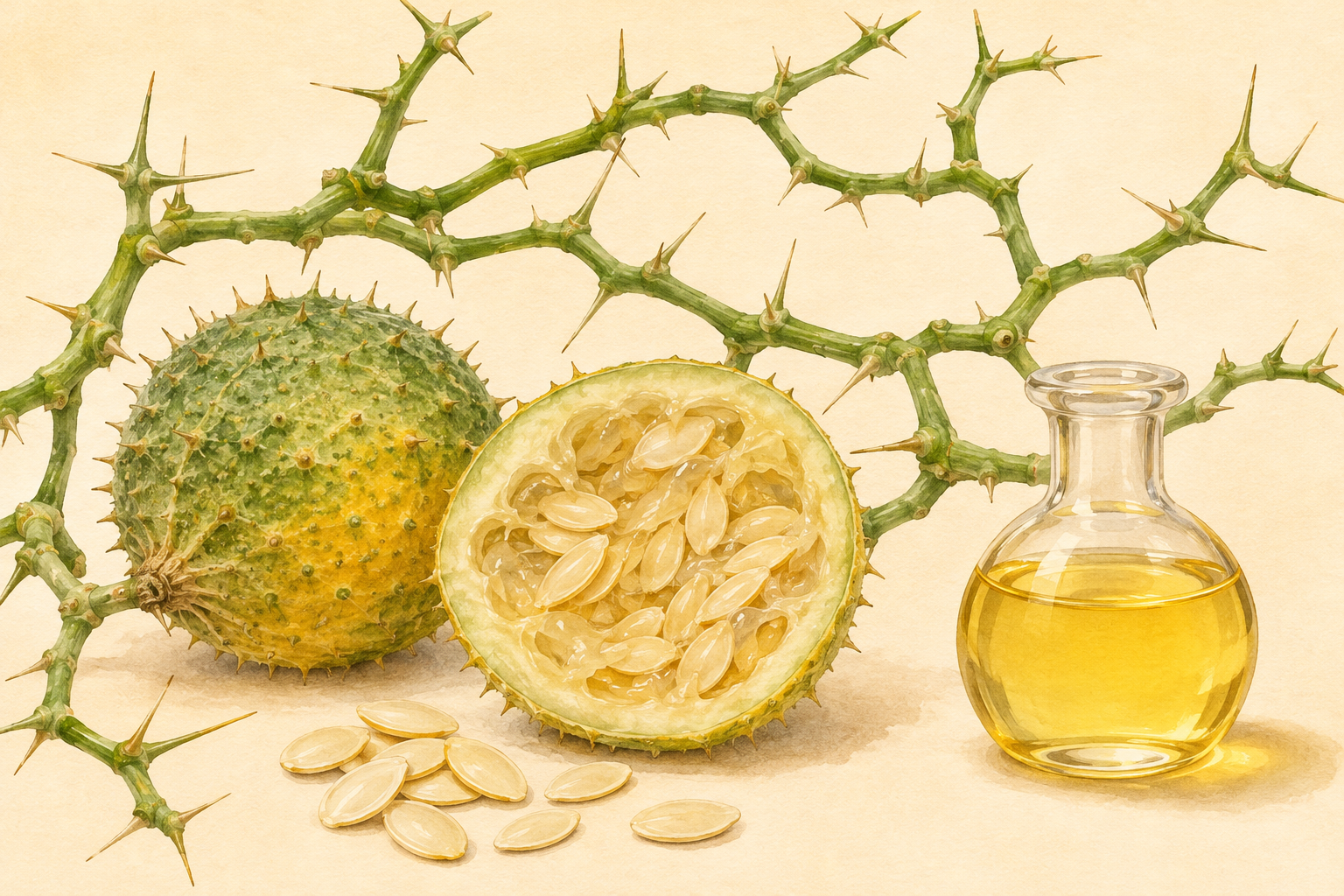
!Nara seed oil is pressed from seeds of Acanthosicyos horridus, a plant endemic to the Namib Desert. Traditional consumption of the fruit and seeds must be distinguished from use of the separated oil.
Source material
Seeds or kernels of Acanthosicyos horridus (Cucurbitaceae). Separating seeds from boiled fruit pulp and pressing oil from those seeds are distinct operations.
Composition
A 2017 comparative study analysed fatty acids and minor components in oils produced by different extraction methods, including cold pressing and solvent extraction. Linoleic acid is a major fatty acid. Laboratory values should not be presented as nutritional guarantees for marketed products, so sample-specific figures are not generalized here.
Region
Namibia, particularly the lower Kuiseb area of the Namib Desert. Topnaar use of the fruit and seeds is documented; commercial cold-pressed oil made from locally purchased seeds was reported in Swakopmund.
Food use
A 2017 study reports !Nara seed oil used in food and cosmetic products sold in Namibia. Traditional community food practices mainly concern fruit and seeds; the study explicitly distinguishes commercial oil production from traditional rural production.
Extraction
Fruit is processed to recover and dry the seeds; commercial oil is obtained by cold pressing. Soxhlet-extracted research samples must not be conflated with marketed edible oil.
Safety
Only products manufactured and labelled for food use should be considered for consumption; cosmetic oil is not automatically food grade. Analytical research does not establish regulatory clearance for every current product. Current food regulations remain unverified.
Sources
1. Characterization of Acanthosicyos horridus and Citrullus lanatus seed oils: two melon seed oils from Namibia used in food and cosmetics applications (2017), https://pmc.ncbi.nlm.nih.gov/articles/PMC5578941/ 2. !Nara resource fact sheet, https://nanci.biz/wp-content/uploads/2020/03/2017-11-22-Fact-sheet-for-resource-base.pdf 3. FAO Ecocrop, Acanthosicyos horridus, https://ecocrop.apps.fao.org/ecocrop/srv/en/cropView?id=31703