THE OIL ATLAS
Japanese torreya seed oil
Overview
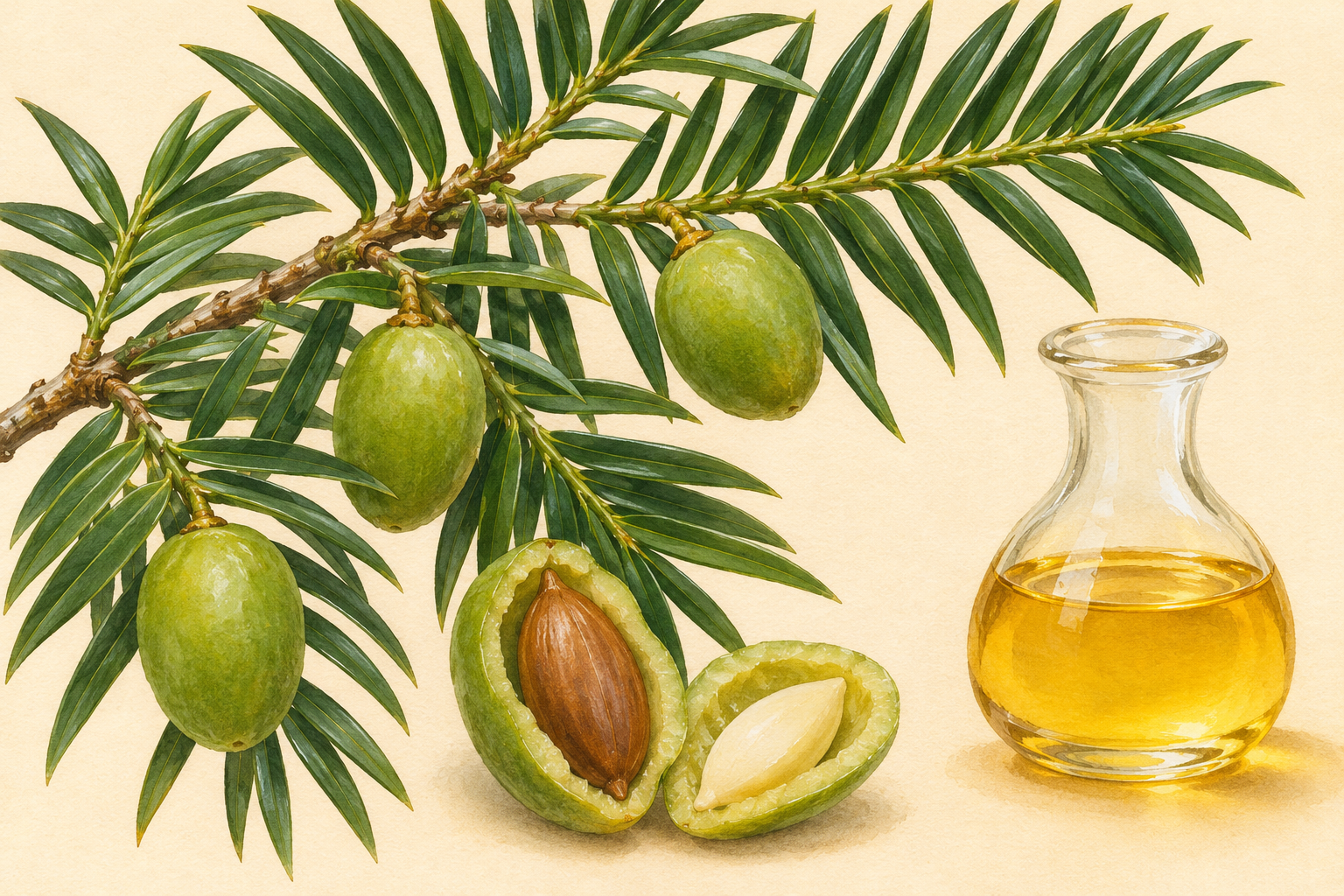
Japanese torreya seed oil is separated from the seeds of Torreya nucifera and is historically documented in Japan as a cooking oil known as kaya-no-abura. This is distinct from eating the seeds themselves.
Source material
The source is the seed of Torreya nucifera (Taxaceae). Roasted edible seeds and extracted seed oil are separate products and uses.
Composition
Japan’s Standard Tables of Food Composition (2023 supplement) report 64.9 g total fat and 53.76 g total fatty acids per 100 g of edible roasted torreya seeds. These are seed values, not the fatty-acid profile or nutrition declaration of extracted oil. A Korean study published in 1980 examined pressed seed oil, but no unverified quantitative oil composition is transferred here.
Region
The oil has a historical Japanese context. A Mie Prefecture document describes pressing torreya seeds for food, lamp fuel and paint; those different uses should not be conflated.
Food use
The FAO publication Non-wood forest products from conifers identifies the production of cooking oil called kaya-no-abura as a principal use of torreya nuts. It does not establish particular modern recipes or current market prevalence.
Extraction
Oil is obtained by pressing the seeds. A Mie Prefecture publication also discusses cold pressing and extraction; this does not prove that all historical producers used identical methods. Laboratory extraction must not be presented as a traditional process.
Safety
Historical food use does not make a cosmetic-grade torreya seed oil suitable for consumption. Food-grade status, product quality controls and present-day sale conditions require product-specific checks. Seed nutrient data must not be copied into oil nutrition labels.
Sources
1. FAO, Non-wood forest products from conifers, “Seeds of Torreya spp.” https://www.fao.org/4/x0453e/x0453e.pdf 2. Mie Prefecture, Japanese torreya seed food information https://www.pref.mie.lg.jp/common/content/001065923.pdf 3. MEXT, Standard Tables of Food Composition in Japan, roasted Japanese torreya seeds https://fooddb.mext.go.jp/details/details.pl?ITEM_NO=5_05007_7&MODE=4 4. Im et al. (1980), Studies on the Lipid Components of Torreya nucifera Seed -I. https://koreantk.com/ktkp2014/thesis/thesis-view.view?ctrlNo=SPGHB5-1980-v12n4-324