THE OIL ATLAS
High-palmitic sunflower oil
Overview
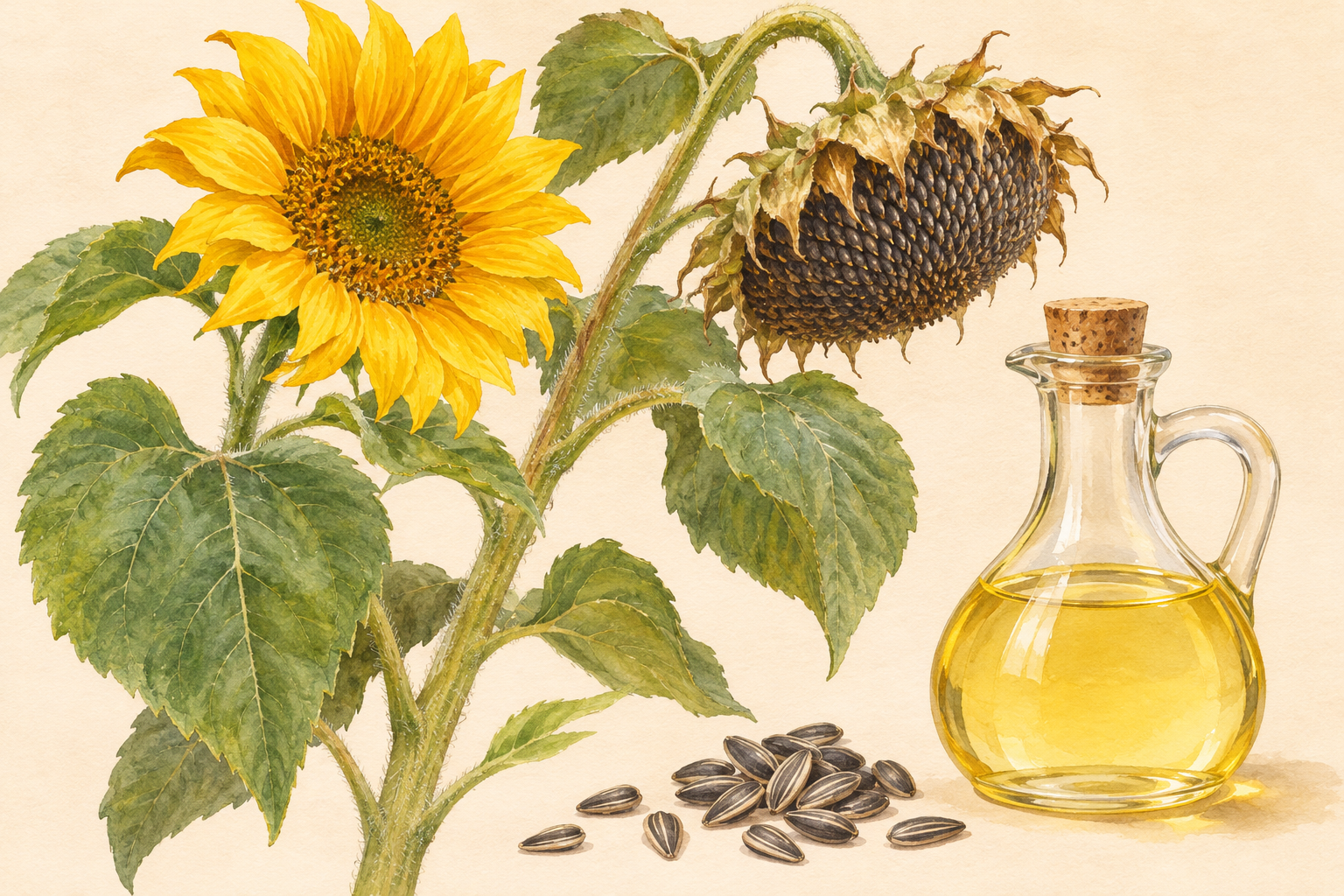
High-palmitic sunflower oil is edible oil separated from seeds of high-palmitic cultivars of Helianthus annuus L. In 2025 Ireland's food-safety authority concluded that oil made by conventional processes from conventionally bred cultivars was not novel under the EU novel-food framework. A specialist overview lists the high-palmitic type among commercially available sunflower-oil variants.
Source material
The source is seed from non-GM sunflower cultivars developed through conventional breeding. This is a fatty-acid-profile variant of the same botanical species used for conventional sunflower oil. The subject is oil separated from seeds, not eating the seeds.
Composition
The Irish Article 4 conclusion states that palmitic acid (C16:0) may reach 35% of total fatty acids, compared with the cited Codex range of 5.0–7.6% for ordinary sunflower oil. These are percentages of fatty acids, not grams per 100 g of product. Guinda et al. (2003) reported 57.7% oleic, 27.8% palmitic and 2.3% linoleic acid in an experimental high-oleic/high-palmitic oil from CAS-12 seeds; this study sample must not be treated as representative of all high-palmitic cultivars.
Region
Ireland’s food-safety authority assessed its EU novel-food status. This does not document sales across Europe or its use in any named regional cuisine. Development and analysis of high-palmitic sunflower varieties are reported in international oil-science literature.
Food use
The EU conclusion describes intended use in food as an alternative source of palmitic acid to palm oil. A specialist review lists high-palmitic sunflower oil among commercially available compositional types. No named retail product or traditional dish is established here, so its availability is not equated with the prevalence of ordinary household sunflower oil.
Extraction
The EU conclusion describes conventional oil-production processes using seeds from conventionally bred, non-GM sunflower plants. Laboratory extraction and testing in individual papers should not be presented as the universal manufacturing process for food-grade products.
Safety
The EU 'not novel' conclusion is a regulatory food-status decision, not hygiene or quality certification for every product. Use food-grade oil complying with applicable law and labelling. A higher palmitic-acid proportion is not presented as a health advantage.
Sources
1. European Commission / Food Safety Authority of Ireland (2025), Article 4 Conclusion: High palmitic sunflower oil. https://food.ec.europa.eu/document/download/4e652943-cca2-4c52-a3f9-8a4d678c15c0_en?filename=novel-food_high-palmitic-sunflower-oil.pdf 2. European Commission, Consultation process on novel food status (entry published 13 August 2025: Not Novel Food). https://food.ec.europa.eu/food-safety/novel-food/consultation-process-novel-food-status_en 3. Guinda et al. (2003), Chemical and physical properties of a sunflower oil with high levels of oleic and palmitic acids. https://doi.org/10.1002/ejlt.200390028 4. Sunflower Oil, specialist review overview listing commercially available compositional variants. https://www.sciencedirect.com/topics/agricultural-and-biological-sciences/sunflower-oil