THE OIL ATLAS
Refined echium seed oil
Overview
Refined echium oil is an edible ingredient made by extracting oil from the seeds of Echium plantagineum and refining it to food specifications. The EU authorised specified food uses in 2008. This does not authorise unrestricted consumption of crude oil or its use as an ordinary frying oil.
Source material
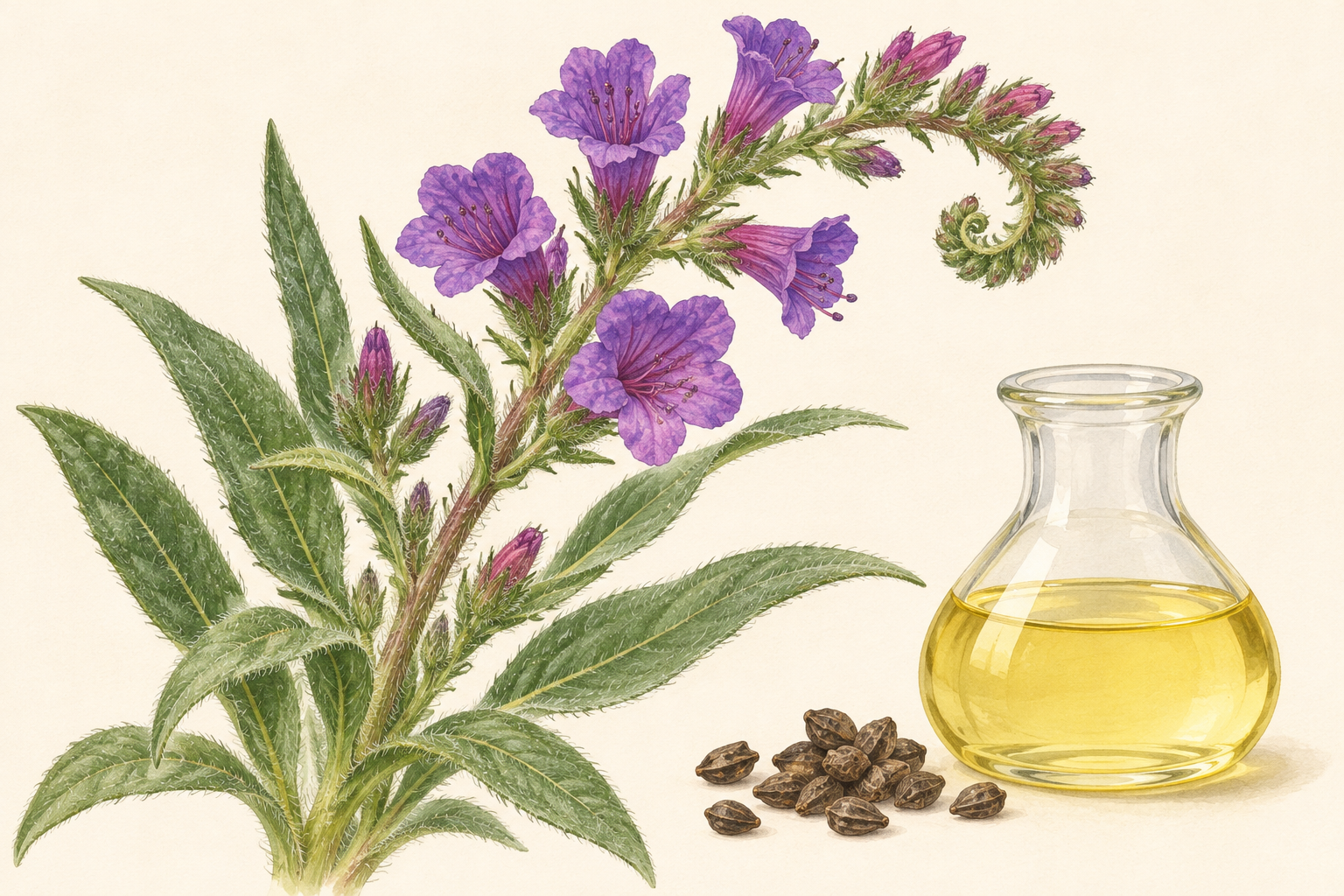
The raw material is the seed of Echium plantagineum (Boraginaceae). Commission Decision 2008/558/EC defines the product as pale-yellow oil obtained by refining extracted seed oil. It is distinct from eating the leaves or flowers and from oils of other Echium species.
Composition
The specification in Commission Decision 2008/558/EC requires stearidonic acid (STA, 18:4 n-3) at not less than 10% by weight of total fatty acids and trans fatty acids at not more than 2% by weight of total fatty acids. These are product specifications, not a measured profile of an individual batch or a nutrient declaration per 100 g.
Region
The EU authorised refined echium oil as a novel food ingredient in 2008. The UK regulated-products register also lists it as authorised in England, Scotland and Wales. These are records of regulated food-market access, not evidence of traditional regional cuisine.
Food use
Permitted food categories include milk-based drinks, cheese preparations, spreadable fats and dressings, breakfast cereals, food supplements, foods for special medical purposes and meal replacements. The maximum STA level is, for example, 750 mg/100 g in spreads and dressings and 625 mg/100 g in breakfast cereals. This does not imply unrestricted direct consumption of the oil.
Extraction
Oil is extracted from seeds and then refined to comply with food-grade specifications. The legal product definition does not prescribe a particular industrial sequence of pressing temperature, solvent treatment or deodorisation. Unverified home-extracted oil is not equivalent to the authorised refined ingredient.
Safety
Commission Decision 2008/558/EC requires pyrrolizidine alkaloids to be non-detectable at a detection limit of 4 μg/kg; peroxide value no more than 5 meq O₂/kg; acid value no more than 0.6 mg KOH/g; and total protein no more than 20 μg/mL. Category-specific STA limits also apply. Crude or non-compliant oils should not be used as food.
Sources
European Commission (2008), Commission Decision 2008/558/EC, Annexes I–II, https://eur-lex.europa.eu/eli/dec/2008/558/oj/eng ; UK Food Standards Agency, Regulated Products Register, Echium plantagineum oil (NOVEL-50; updated 2025-04-01), https://data.food.gov.uk/regulated-products/novel_authorisations/novel-50