THE OIL ATLAS
Tamal fat / Garcinia morella seed fat
Overview
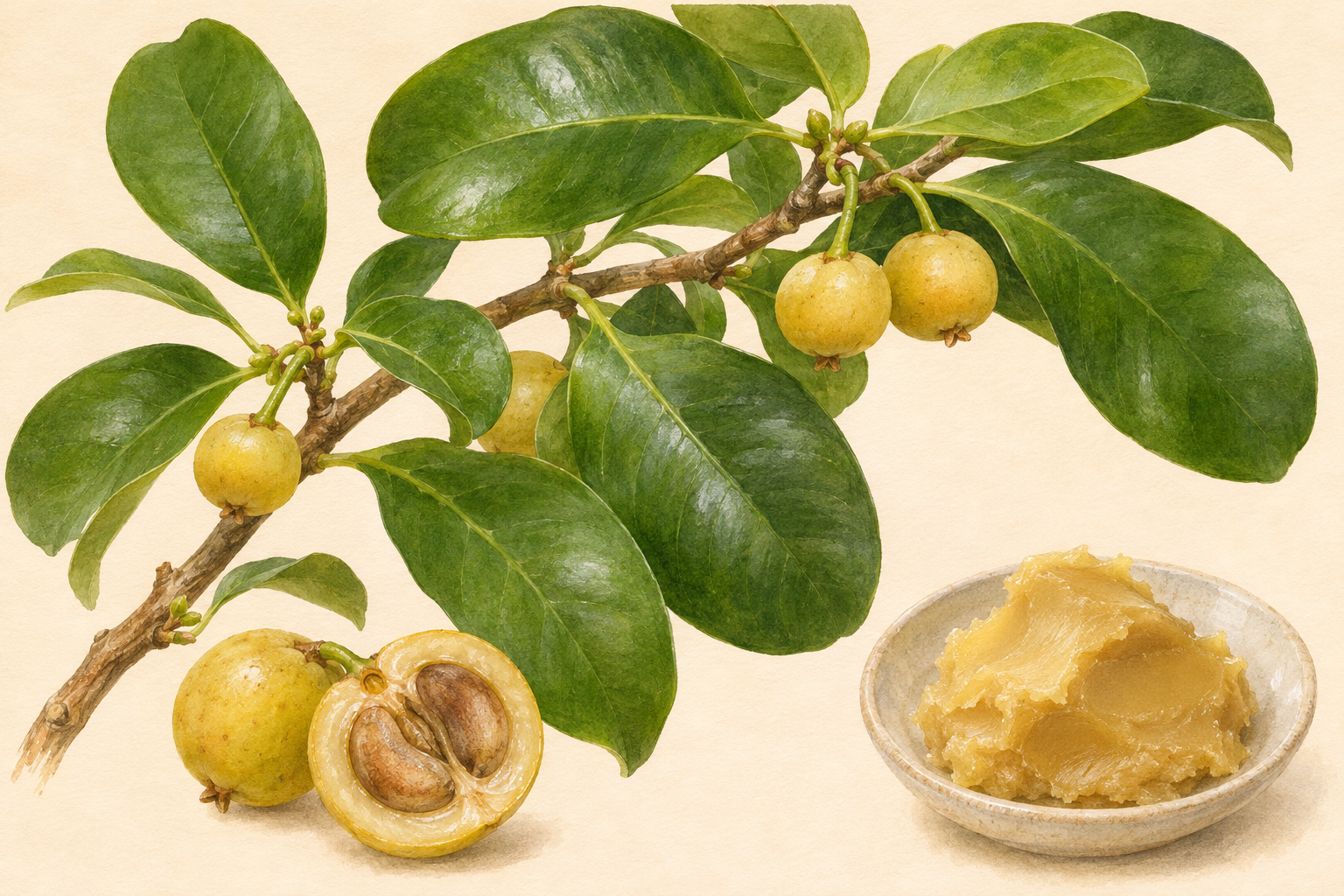
Tamal fat is a yellow-brown vegetable fat separated from the seeds of Garcinia morella. It has historically been used in cooking as a substitute for ghee, particularly in India. This is distinct from eating the fruit pulp or using the tree resin.
Source material
Seeds of Garcinia morella (Gaertn.) Desr.; also called tamal fat or tamal butter. It must not be confused with the yellow gamboge resin obtained from the bark.
Composition
PROSEA reports approximately 46% stearic acid and 50% oleic acid in tamal fat (percentages of fatty acids, not grams per 100 g of retail product). A separate analysis cited by a 2020 review reports 44.95% stearic, 45.38% oleic and 7.77% linoleic acids in seed oil. The original study should be consulted for full sample conditions; these are not guaranteed product specifications.
Region
PROSEA describes a range from India, Sri Lanka and Bangladesh through parts of Southeast Asia. Traditional edible-fat use is documented especially in Indian contexts. Present-day distribution and market volume by country have not been established.
Food use
PROSEA specifically documents use of the separated fat in cooking, mainly as a substitute for ghee. A 2020 scientific review also describes culinary and confectionery uses. Specific named dishes and the prevalence of present-day household use remain unverified.
Extraction
The fat is separated from the seeds. PROSEA describes tamal fat as yellow-brown, softer than kokum butter, and melting at about 33°C. Detailed traditional extraction steps and food-grade refining conditions have not been verified and are not inferred here.
Safety
Documented historical culinary use does not establish current food authorization in every jurisdiction. Only appropriately controlled food-grade material should be considered for food use. Bark-derived gamboge resin is a different substance and must not be substituted for the seed fat. Current country-specific food regulatory status remains unverified.
Sources
1. PROSEA, Garcinia L., Plant Resources of South-East Asia: https://prosea.prota4u.org/view.aspx?id=831 2. Phytochemicals and Biological Activities of Garcinia morella (Gaertn.) Desr.: A Review, Molecules 2020, 25(23), 5690: https://pmc.ncbi.nlm.nih.gov/articles/PMC7730552/ 3. Botanical Survey of India, Flora of India, Garcinia morella: https://bsi.gov.in/uploads/documents/Public_Information/publication/books/Flora%20of%20India%20latest/FLORA%20OF%20INDIA%20VOL.3.pdf