THE OIL ATLAS
Mbokaja palm kernel oil
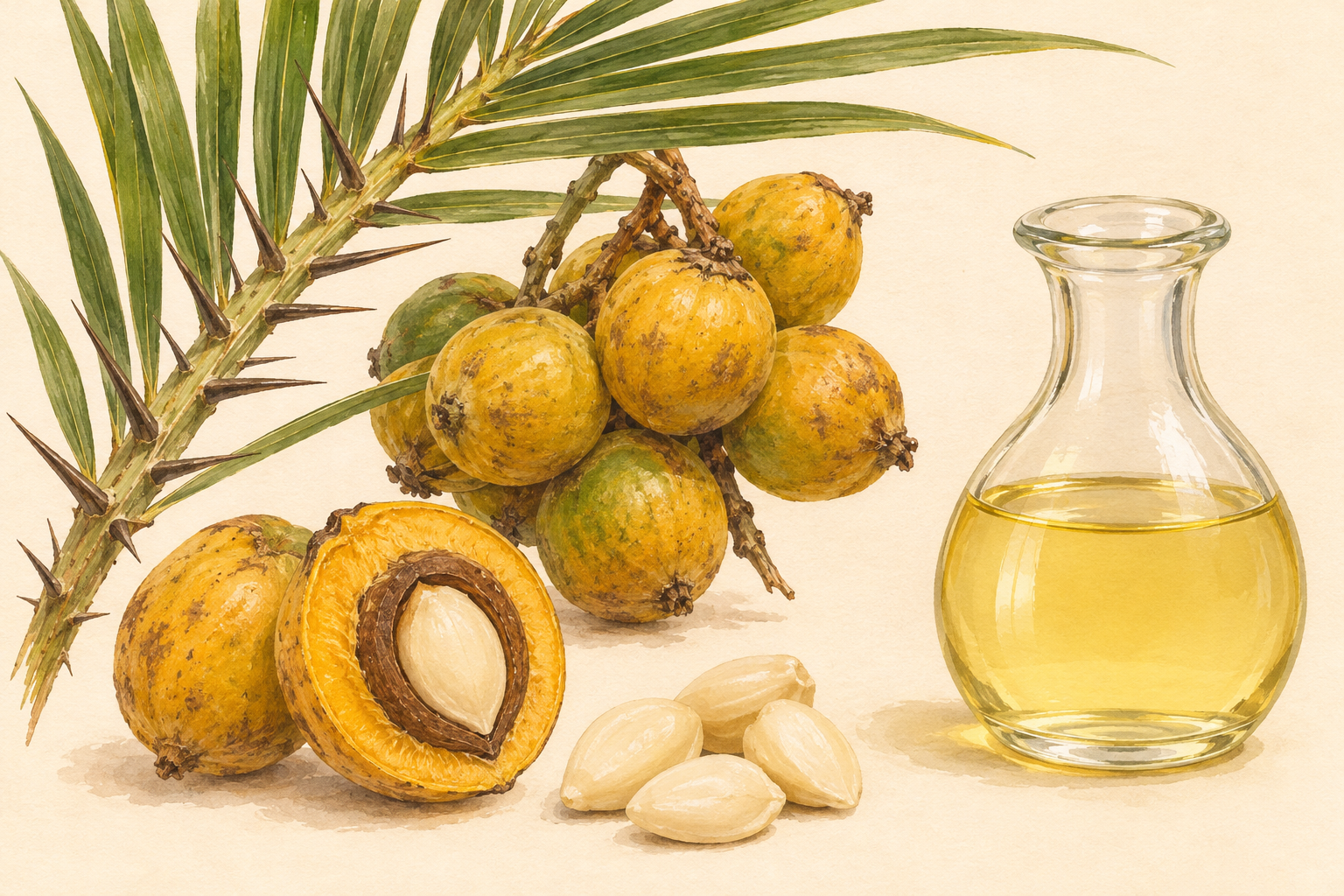
Overview
Oil separated from mbokaja kernels, with records of commercial production and edible use in Paraguay. It differs from pulp oil; current household-use frequency is not established.
Source material
Kernel inside the hard fruit stone of Acrocomia totai, sometimes treated in the cited literature within the Acrocomia aculeata taxonomic complex. The pulp yields a different oil.
Composition
No quantitative fatty-acid or nutrient figures are included because the available records do not establish a specific measured kernel-oil sample and its conditions.
Region
Commercial kernel-oil production in Paraguay was described in a 1955 oil-industry publication. Current regional food-market volumes are not established.
Food use
A reference describes refined Acrocomia totai kernel oil as an important cooking oil in Paraguay and Bolivia, without identifying dishes or current household-use frequency.
Extraction
The kernel is separated from the hard stone and oil is recovered from it. Historical commercial production is documented, but extraction temperatures and refining specifications are not verified here.
Safety
Historical culinary use does not establish modern food-grade quality or legal authorization for every product. Oil sold for soap or cosmetics must not be assumed edible.
Sources
Markley (1955), “The mbocayá palm: An economic oil plant of Paraguay,” Journal of the American Oil Chemists’ Society 32:405–414, https://doi.org/10.1007/BF02639697 ; Facciola, Cornucopia II, Arecaceae, https://lo2.org/pdf/bio_eco/facciola.cornucopia_ii.pdf ; Benítez et al. (2011), Steviana 3, https://revistascientificas.una.py/index.php/stevia/article/download/1289/1276/2365 .