THE OIL ATLAS
Huayllabamba sacha inchi oil
Overview
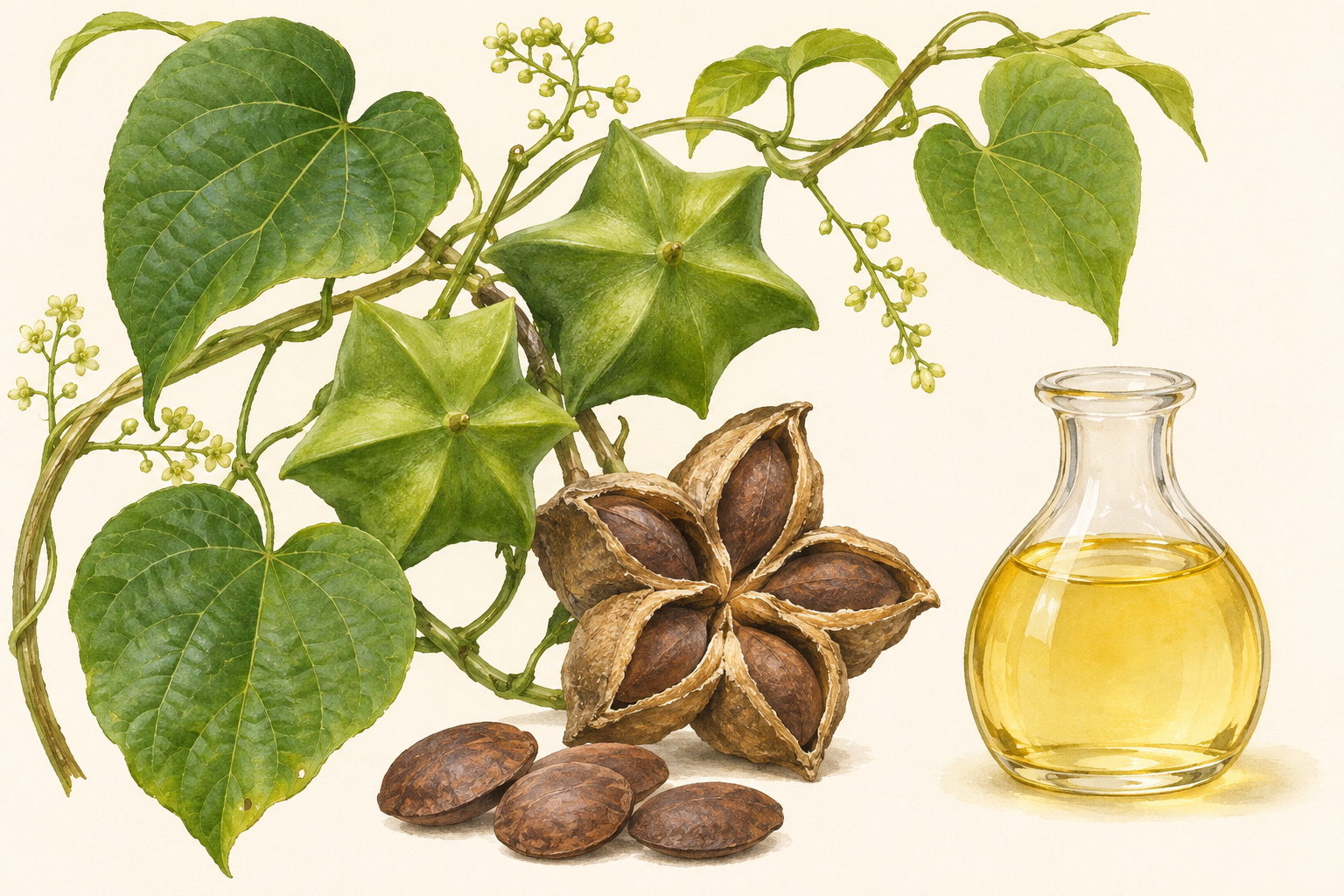
Huayllabamba sacha inchi oil is oil separated from the seeds of Plukenetia huayllabambana. The separated oil is studied as an edible sacha inchi oil, including in research on microencapsulated edible oils. No named local dish or household prevalence is established.
Source material
The source is the seeds of Plukenetia huayllabambana. Eating the raw material and using its separated oil are distinct practices.
Composition
| Measure | Reported value | Sample, units and source |
|---|---|---|
| Seed-oil yield | 30.3–41.2% | 2014 Amazonas seed samples; extraction yield |
| Alpha-linolenic acid | 51.3 g/100 g oil | 2014 comparative study of extracted oil |
| Alpha-linolenic acid | 53.20% | 2025 study; relative fatty-acid composition |
| Linoleic acid | 29.17% | Same 2025 analysis |
| Oleic acid | 10.13% | Same analysis |
Values from different studies must not be combined into a specification for one product.
Region
The verified sources concern Amazonas, Peru. Distribution of the plant does not by itself establish culinary use of its separated oil.
Food use
The separated oil is studied as an edible sacha inchi oil, including in research on microencapsulated edible oils. No named local dish or household prevalence is established.
Extraction
A 2014 study analyzed oil from seeds collected over two harvests in Amazonas and reported a seed-oil yield of 30.3–41.2%. This is a research-sample yield, not a specification for all commercial products.
Safety
The high polyunsaturated-fat content makes protection from light, oxygen and heat important. Research use as edible oil does not certify every unverified product as food-grade.
Sources
1. Chasquibol et al., 2014, Journal of Agricultural and Food Chemistry: https://pubmed.ncbi.nlm.nih.gov/25228323/ 2. Chirinos et al., 2015, Food Chemistry: https://pubmed.ncbi.nlm.nih.gov/25466144/ 3. Comparative fatty-acid and toxicity study, 2025: https://pmc.ncbi.nlm.nih.gov/articles/PMC12554714/ 4. Microencapsulation of edible sacha inchi oils, 2019: https://pmc.ncbi.nlm.nih.gov/articles/PMC6963851/