THE OIL ATLAS
Jacket plum seed oil
Overview
Caution: records of edible oil coexist with purgative use. Safe intake conditions remain unverified.
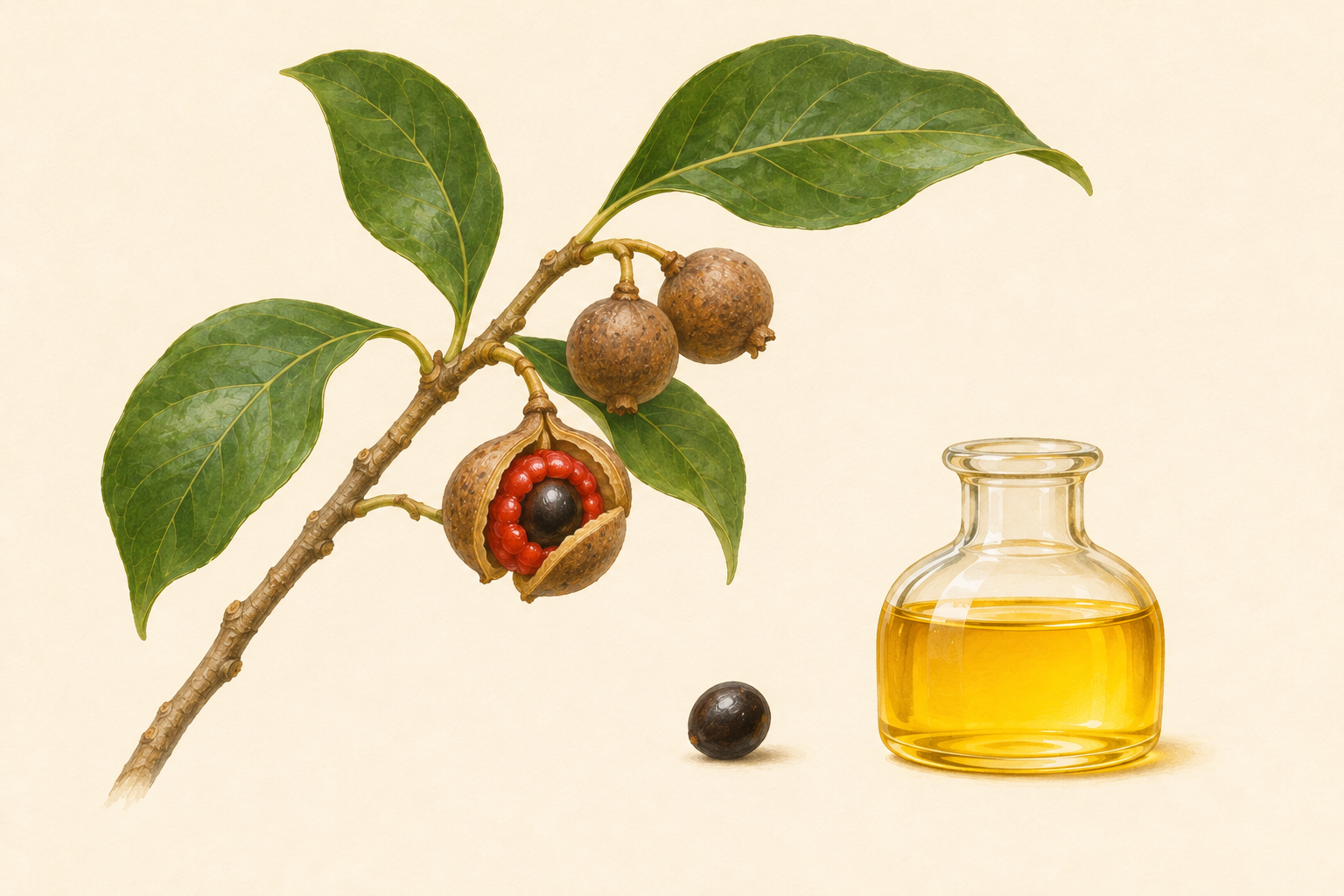
Jacket plum seed oil is separated from the seeds of Pappea capensis. SANBI describes a golden oil extracted from roasted seeds, while the ECHO plant record incorporating Food Plants International explicitly identifies the seeds as a source of edible oil. This is distinct from eating the fruit.
Source material
The source is the roasted seeds of Pappea capensis. Eating the raw material and using its separated oil are distinct practices.
Region
The verified sources concern southern Africa. Distribution of the plant does not by itself establish culinary use of its separated oil.
Food use
The ECHO/Food Plants International species record identifies the seeds of Pappea capensis as a source of edible oil, providing documentary evidence for the separate seed oil as a food material. It does not establish a named dish, frequency of household cooking, or current commercial distribution. SANBI mainly records medicinal, lubricating and soap uses; those non-food uses are not presented as proof of culinary practice.
Extraction
Sources document oil separation but do not establish universally validated food-safe processing conditions.
Safety
A record identifying the seeds as a source of edible oil does not establish that every extraction method or product meets food-safety requirements. SANBI also describes use of the oil as a purgative. Unverified, unrefined oil should not be recommended for self-directed consumption. Present-day food regulations, product specifications and consumption safety require separate review.
Product-specific compliance in Japan, the US and EU and safe intake conditions remain unverified. Purchase, consumption and home extraction or detoxification are not recommended here.
Sources
1. South African National Biodiversity Institute, PlantZAfrica, “Pappea capensis” (roasted-seed extraction and non-food uses), https://pza.sanbi.org/pappea-capensis 2. ECHOcommunity / Food Plants International, “Pappea capensis” (seeds identified as a source of edible oil), https://www.echocommunity.org/dyu/resources/f1f43bb5-1e3c-47ab-a85e-5e3c9384832d 3. World Agroforestry, “Pappea capensis (Pappea ugandensis)” (medicinal and soap uses), https://apps.worldagroforestry.org/usefultrees/pdflib/Pappea_capensis_TZA.pdf