THE OIL ATLAS
Raffia palm mesocarp oil
Overview
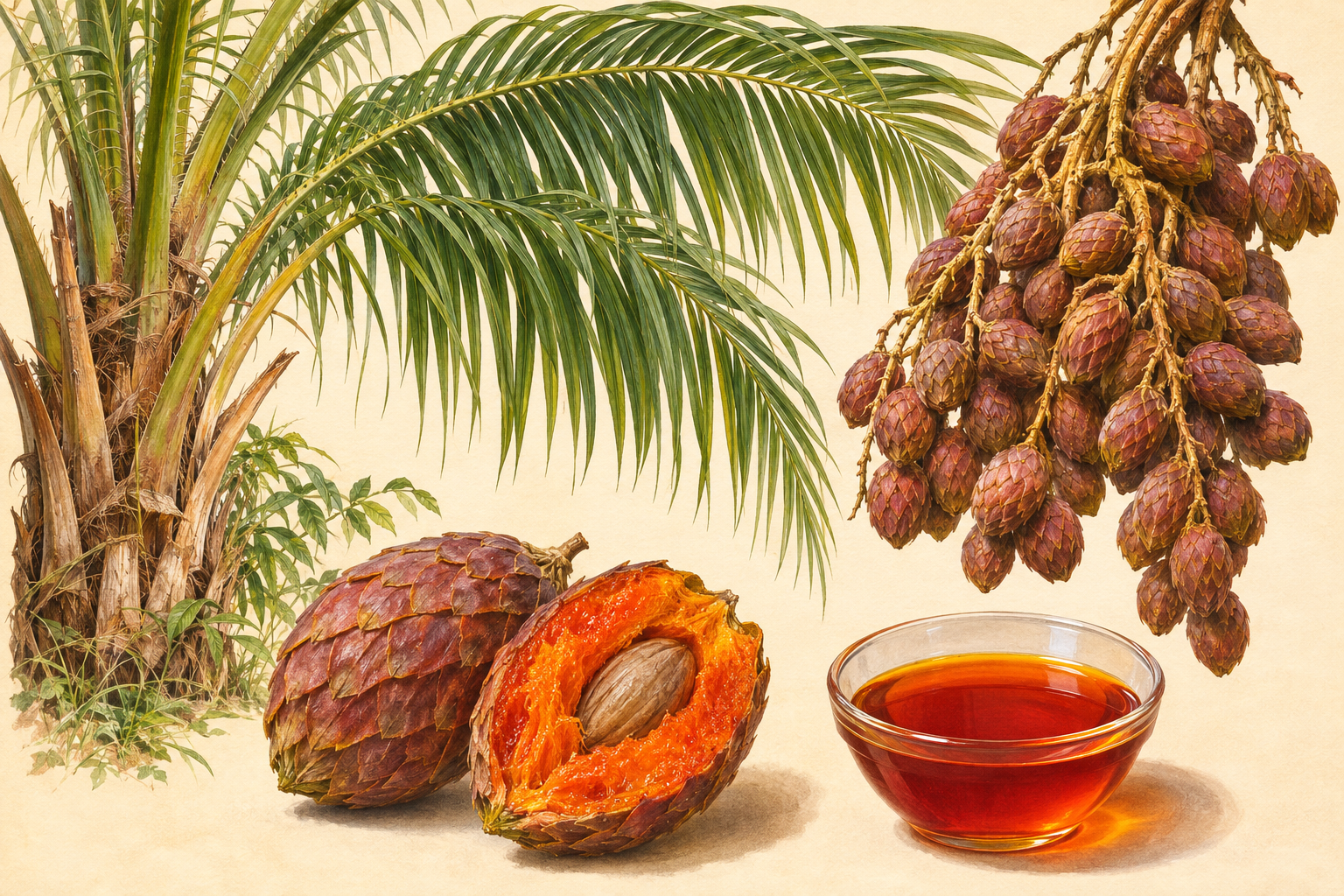
Oil separated from the fruit pulp of Raphia hookeri. Field-based taxonomy in the Republic of the Congo records production of a red oil called Kolo in Mbochi.
Source material
The material is pulp of Raphia hookeri G.Mann & H.Wendl., distinct from kernel oil or sap wine. Older Kolo literature identifies R. sese; the 2026 authors suggest the sampled palm was probably R. hookeri on the basis of specimens and local names. This does not establish synonymy between the species.
Composition
Because the older samples have an identification caveat, their fatty-acid values are not presented as a standard profile for this species.
Region
Use is documented among the Mbochi in the northern Republic of the Congo. Uses of other raffia species elsewhere are not transferred to this species.
Food use
The field study identifies places producing Kolo pulp oil and connects them with earlier oil research. This is distinct from eating fermented pulp, called pandé. The regional commodity is also discussed in the Kolo raffia fruit-pulp oil article.
Extraction
The oil is separated from fruit pulp. Oil production should not be conflated with preparation of fermented pulp as food.
Safety
Traditional use and botanical identification do not certify present-day oil products. Processing, storage, oxidation, contamination tests and product-specific food compliance require separate verification. Home extraction and consumption are not recommended here.
Sources
Ndolo Ebika et al. (2026), Synopsis of the genus Raphia in the Republic of the Congo, PhytoKeys 271:37–71, Raphia hookeri: Uses and Taxonomic notes. https://doi.org/10.3897/phytokeys.271.174506 Silou et al. (2000), Tropicultura 18(1):26–31(older identification: R. sese). https://doaj.org/article/9bd049d94a584e7caea997f193571a6b