THE OIL ATLAS
Papuan red fruit oil
Overview
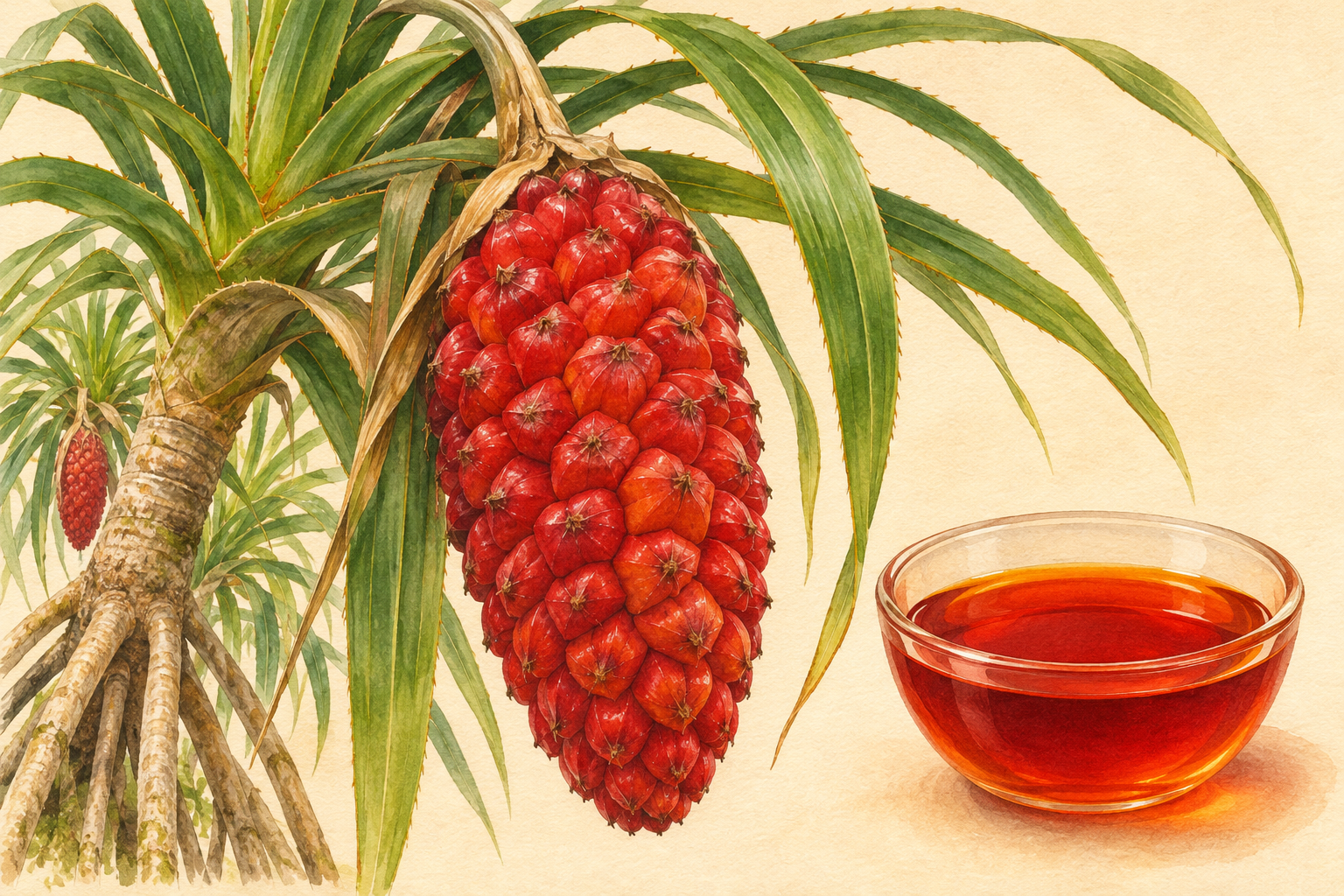
Papuan red fruit oil is separated from the red fruits of Pandanus conoideus, a plant of New Guinea. It is traditionally known as a source of edible oil in Indonesian Papua. The separated oil should be distinguished from direct consumption of the fruit.
Source material
The material is the oil-bearing portion of the red fruit of Pandanus conoideus. A 2015 study extracted and analysed oil from nine clones cultivated in three areas of Papua. This red fruit oil should not be conflated with oils from other Pandanus species.
Composition
Sarungallo et al. (2015) analysed oil extracted with chloroform–methanol (2:1) from nine clones grown in three areas of Papua. They reported oleic acid at 49.36–64.47 g/100 g, linoleic acid at 4.13–16.06 g/100 g and palmitic acid at 14.11–19.21 g/100 g; total tocopherols were 234–1,728 ppm and total phenols 90–742 ppm. Clone-dependent ranges from laboratory extracts must not be represented as universal values for commercial or traditionally produced oil.
Region
The source identifies the oil as a traditional edible oil of Indonesian Papua and examines clones cultivated in three areas of Papua. It does not establish identical preparation or culinary practice throughout the island of New Guinea.
Food use
The source describes red fruit as a traditional edible-oil source, without identifying specific dishes or household quantities.
Extraction
Traditional processing should be distinguished from laboratory extraction. The 2015 study used a chloroform–methanol (2:1) mixture to obtain analytical oil samples. This is not a food-production method or a home-extraction instruction.
Safety
Traditional food use does not establish the safety, oxidation state or health benefits of every marketed product. The study reported free fatty acids of 4.3–9.2% and peroxide values of 0.36–0.84 meq/kg for its nine-clone analytical samples; these are not universal food-safety specifications. Laboratory solvent extracts must not be consumed as food.
Sources
Sarungallo, Z. L., Hariyadi, P., Andarwulan, N. & Purnomo, E. H. (2015). Characterization of Chemical Properties, Lipid Profile, Total Phenol and Tocopherol Content of Oils Extracted from Nine Clones of Red Fruit (*Pandanus conoideus*). Agriculture and Natural Resources 49(2), 237–250. https://li01.tci-thaijo.org/index.php/anres/article/view/243566