THE OIL ATLAS
Radish seed fixed oil
Overview
Caution: safety depends on cultivar, composition and product conditions; a sales label alone does not establish safety.
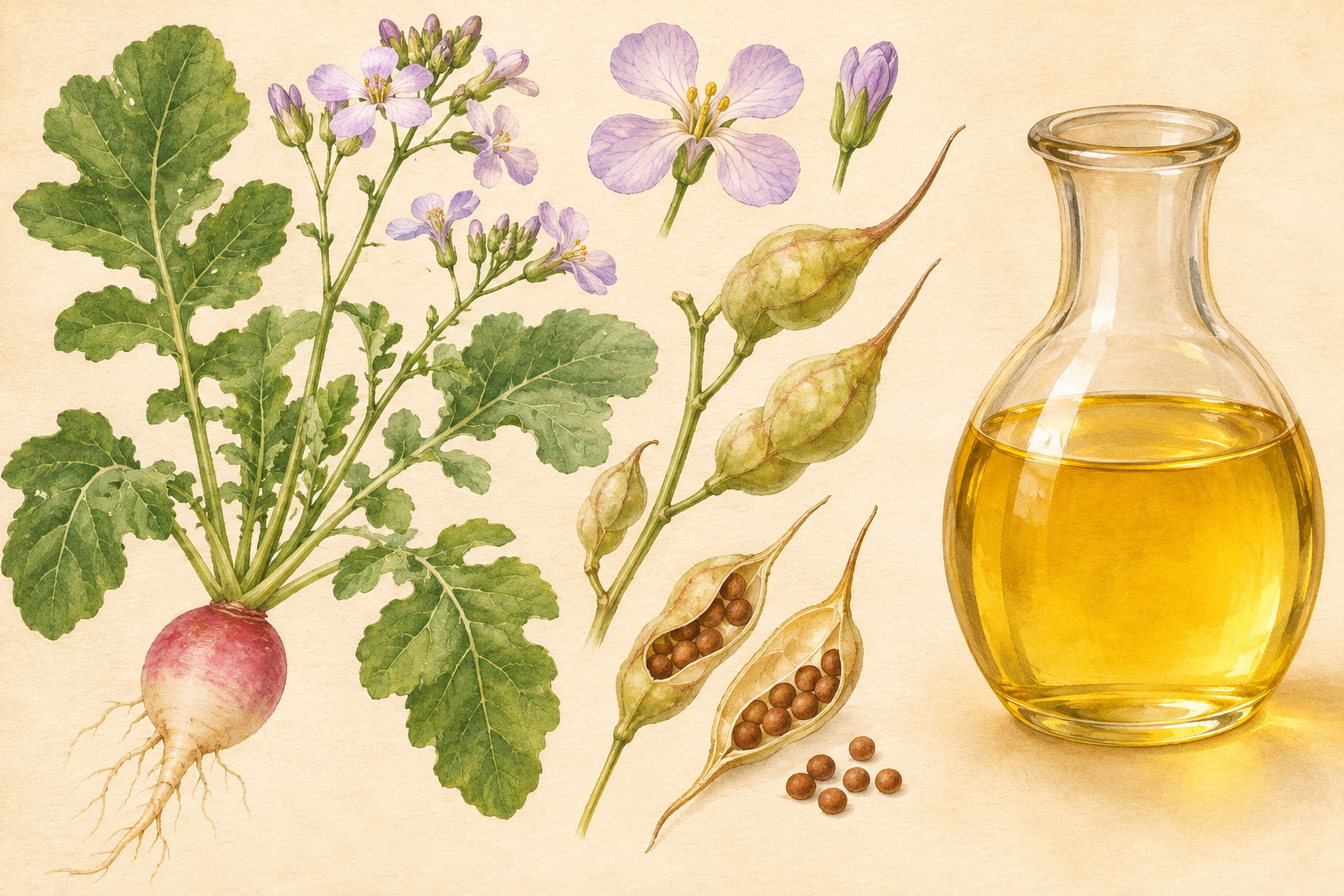
Oil separated from radish seeds. In Korea, gegeol radish seed oil is sold in bottles with an edible-oil category on the producer’s label. This is distinct from eating roots or leaves.
Source material
Seeds of radish recorded as Raphanus sativus. Korea’s Rural Development Administration also lists gegeol radish under that name. Root nutrient values do not describe seed oil.
Region
A producer in Yeoju, Gyeonggi-do, records sale of the seed oil for food. This does not establish oil extraction or consumption throughout the crop’s range.
Food use
The producer’s 180 ml product is labelled “other edible oils and fats” and contains 100% Yeoju gegeol radish seeds. It documents sale of separated oil for food, beyond experimental incorporation in meat products. No particular culinary use is recommended here.
Extraction
The producer offers pressed oil, with process variants including differences in roasting. This does not establish a single manufacturing process for all radish seed oils. Home extraction instructions are not provided.
Safety
Erucic acid can be a concern in brassica seed oils; a batch-specific erucic-acid result for this product has not been verified. EFSA’s assessment derives a chronic health-based value from animal studies, not a safety guarantee for every seed oil. The Korean sales category does not establish compliance in Japan, the US or EU. Purchase and consumption are not recommended here.
Sources
Yeoju Gegeolmu Seed Farm, product food label: https://gegulmu.com/m/product_detail.html?brand_uid=10309016 Rural Development Administration, Standard Food Composition Table (gegeol root identity, not oil nutrition): https://www.rda.go.kr/download_file/act/bookcafe078.PDF EFSA, Erucic acid in feed and food (2016, amended 2017): https://doi.org/10.2903/j.efsa.2016.4593