THE OIL ATLAS
Date seed oil
Overview
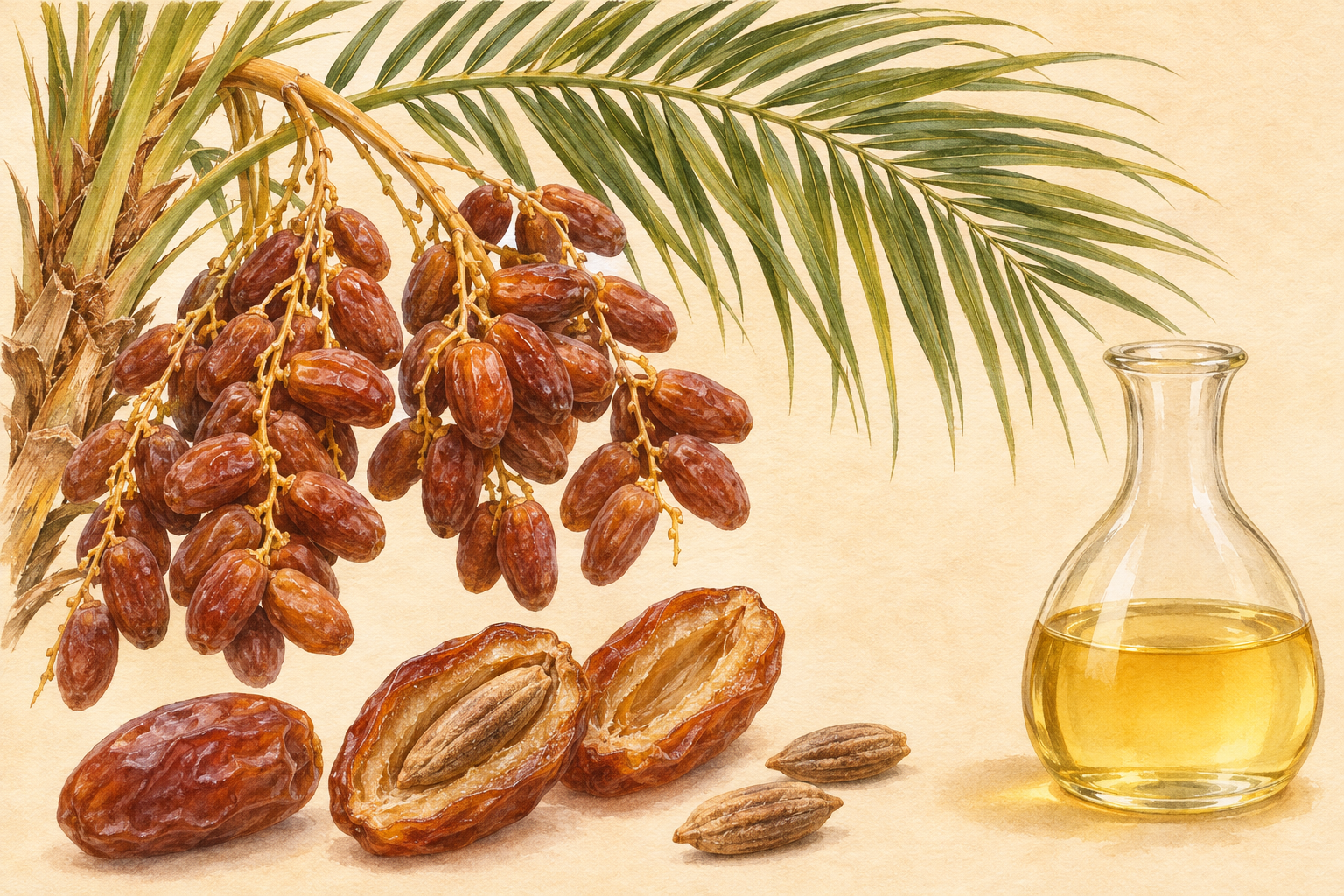
Date seed oil is separated from the seeds of the date palm (Phoenix dactylifera L.). It is distinct from eating date flesh or drinking beverages made from roasted seeds. Food studies have actually incorporated the separated oil into mayonnaise and bakery margarine, including sensory evaluation. This does not establish a tradition of household cooking with the oil.
Source material
The oil is extracted from date seeds of Phoenix dactylifera.
Composition
A 2020 review describes date seeds as containing 5–13% oil and identifies oleic acid as a major unsaturated fatty acid and lauric acid among the saturated fatty acids. Seed oil content is not nutrition per 100 g of oil. A 2025 review cites different seed lipid values of approximately 2–3.2% and reports studies with oleic acid above 50% of total fatty acids in extracted oil. Differences in samples and analytical conditions preclude combining these figures into a single product specification.
Region
Date palms are widely cultivated, but the location of seed-oil food research does not establish a traditional region of oil consumption. The cited evidence primarily concerns experimental formulation in processed foods.
Food use
A food study reported by Basuny and Al-Marzooq (2011) used date seed oil in mayonnaise and recorded better sensory qualities than a corn-oil control. A separate study incorporated roasted date seed oil into bakery margarine. These are documented uses of the separated oil in foods that were made and evaluated, but they do not demonstrate widespread retail use or a traditional regional cuisine.
Extraction
Date seeds may be pressed for oil. In research, the seeds may be dried and milled before extraction; laboratory extraction and hygienic manufacture of food-grade oil are not necessarily the same. Processing date flesh or making a beverage from roasted seeds does not describe manufacture of the separated seed oil. These reports do not establish a traditional culinary oil-making method.
Safety
Use in experimental foods does not certify every commercially offered seed oil. Food use requires oil manufactured for consumption and compliant with applicable limits for acidity, residual solvent, oxidation and contaminants. The hard seed is not a basis for recommending improvised home extraction.
Sources
1. Mrabet et al. (2020), Date Seeds: A Promising Source of Oil with Functional Properties, Foods 9, 787. https://pmc.ncbi.nlm.nih.gov/articles/PMC7353509/ 2. Current insights into date by-product valorization for sustainable food industries and technology (2024), Sustainable Food Technology. Table 2 records date-seed oil mayonnaise and sensory comparison, citing Basuny and Al-Marzooq (2011). https://pubs.rsc.org/en/content/articlehtml/2024/fb/d3fb00224a 3. Investigating the Impact of Roasted Date Seed Oil on the Quality and Oxidative Stability of Bakery Margarine (2025), Journal of the American Oil Chemists' Society. https://doi.org/10.1002/aocs.12976 4. Besbes et al. (2005), Heating effects on some quality characteristics of date seed oil, Food Chemistry 91, 469–476. https://doi.org/10.1016/j.foodchem.2004.04.037