THE OIL ATLAS
Camel hump fat
Overview
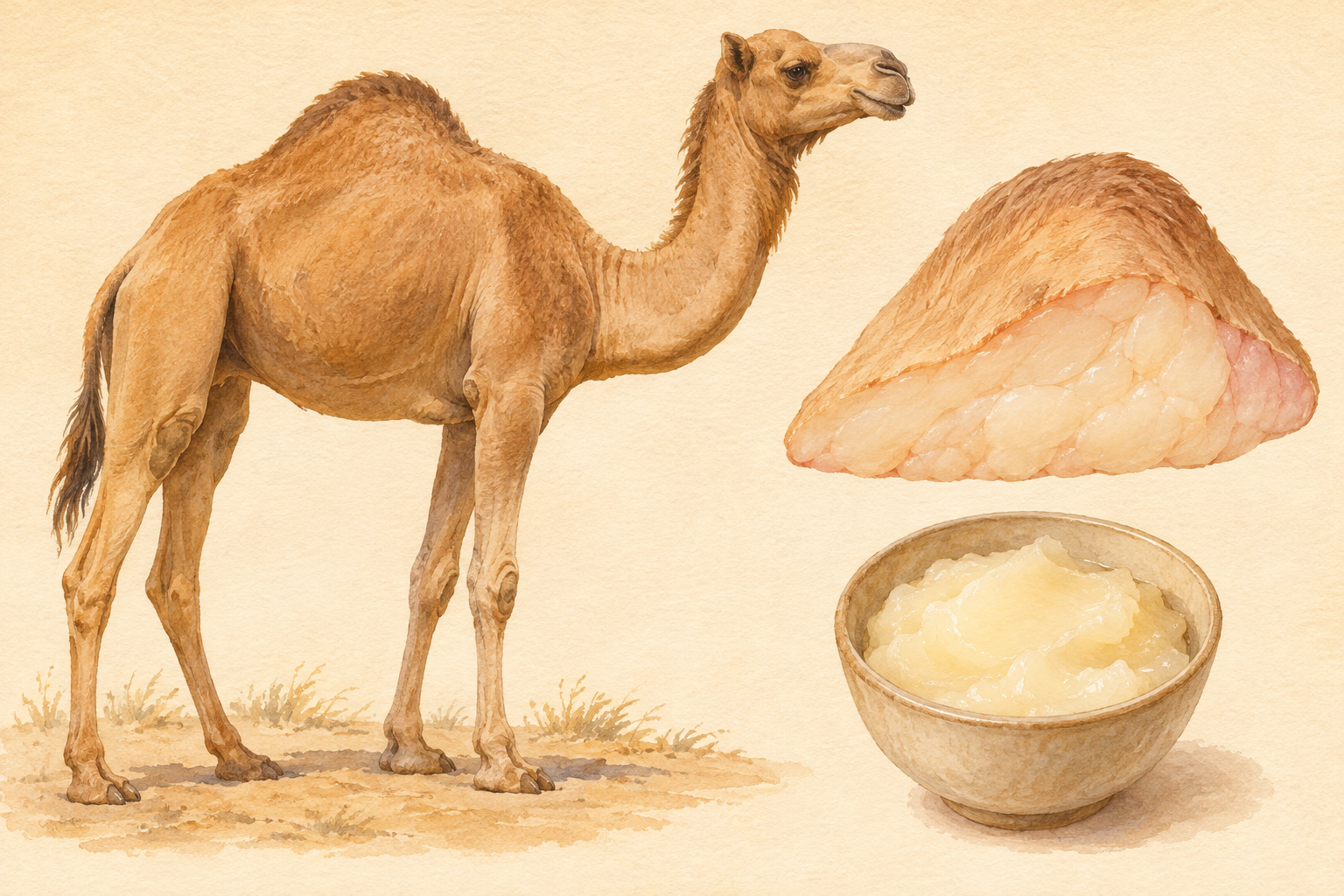
A cooking fat rendered from the adipose tissue of a camel’s hump. In the Kenyan dish nyrinyiri, hump fat is melted out and used to cook camel meat. This is separate from eating pieces of hump tissue.
Source material
The source is hump adipose tissue, chiefly from the dromedary camel (Camelus dromedarius). Where a culinary record does not specify camel species, it is not automatically attributed to the Bactrian camel.
Composition
The FAO Kenyan recipe collection gives 33.6 g fat per 100 g of the finished nyrinyiri dish. This is a whole-recipe value, not a fatty-acid profile or nutrient analysis of isolated hump fat. No sample-verified oil-specific fatty-acid percentages are supplied.
Region
The FAO recipe book identifies nyrinyiri with Borana, Gabra, Rendille and other pastoralist communities in Kenya. A survey of khlii in southwestern Algeria documents a mixture of hump and kidney fat used with meat; that mixture is not treated as pure hump fat.
Food use
For nyrinyiri, hump pieces are heated to release oil, which is then added to camel meat during cooking. The FAO example specifies 544 g of hump as an ingredient and 257 g of prepared hump oil used in the recipe; these are recipe quantities, not a generalized extraction yield.
Extraction
Hump adipose tissue is cut and heated to release cooking fat. The FAO recipe explicitly describes collecting oil for cooking, but does not establish industrial refining or a standardized filtration process.
Safety
Handle animal fat hygienically and account for water or meat juices and storage temperature. Traditional preservation practices do not guarantee the safety of prolonged room-temperature storage in modern households. Food-grade status must be assessed by market.
Sources
FAO et al., Kenyan Food Recipes: A Recipe Book of Common Mixed Dishes with Nutrient Values, Nyrinyiri (Camel Meat), KFCT Code 15047, p.173. https://www.fao.org/4/i9056en/I9056EN.pdf Benyagoub et al., An Investigation Into the Traditional Processing of Camel Meat as Khlii, Asian Journal of Dairy and Food Research (2025). https://arccjournals.com/journal/asian-journal-of-dairy-and-food-research/DRF-509