THE OIL ATLAS
Cohune palm kernel oil
Overview
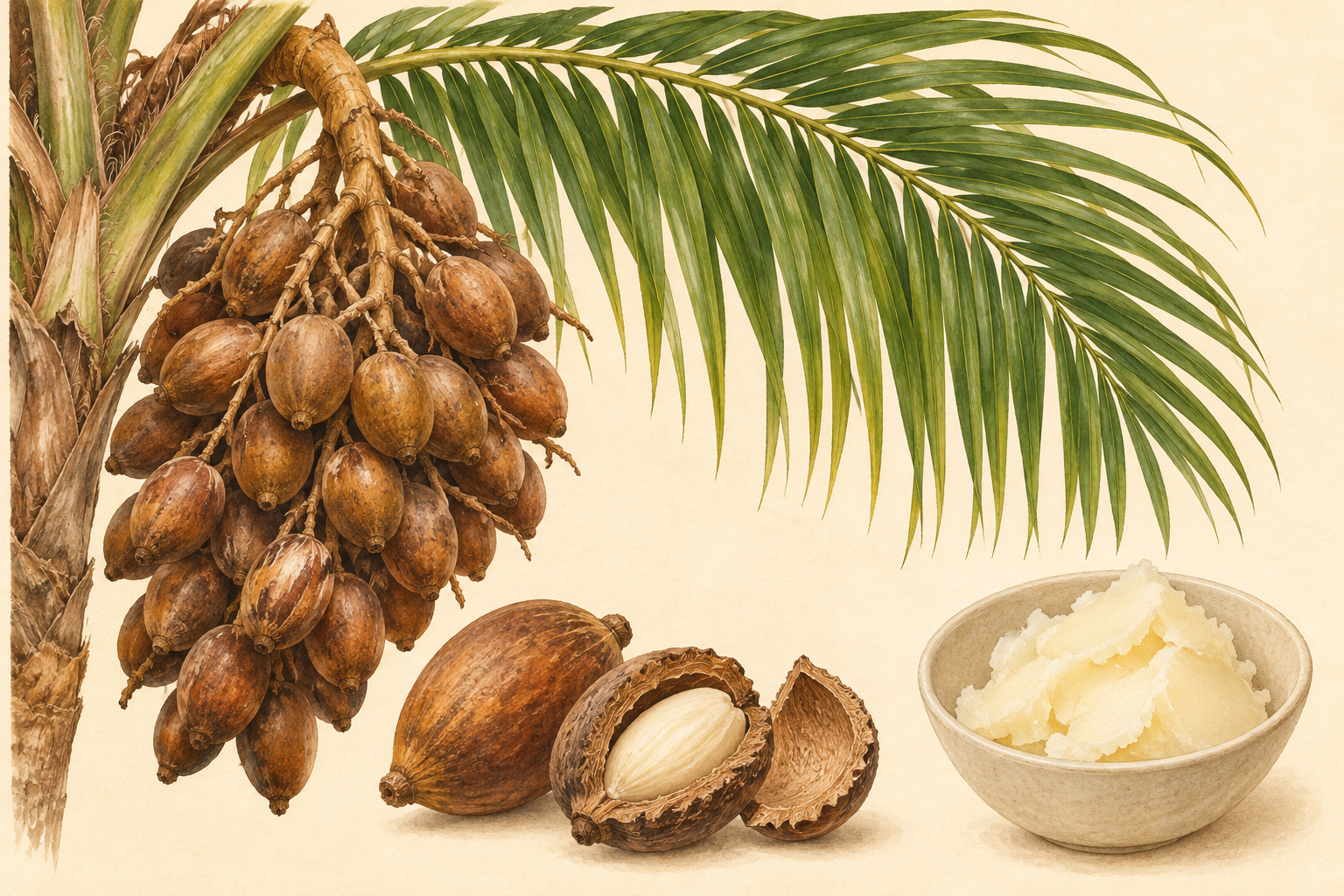
Cohune palm kernel oil comes from the hard-shelled fruit of Attalea cohune (formerly Orbignya cohune). Comparable in some uses to coconut oil, it has documented small-scale extraction and local trade in Central America. It is distinct from fruit-pulp oil, milk-like preparations of immature kernels, and eating the kernels whole.
Source material
The raw material is the kernel enclosed by a hard endocarp. FAO reports 65–72% oil in the kernel and around 13% in the pulp, which are different raw materials. PROSEA reports roughly 52% fat in the seed; these figures have different sample definitions and should not be averaged.
Composition
FAO’s Minor Oil Crops, citing Godin, gives the following fatty-acid composition of separated cohune kernel oil (% of total fatty acids): caprylic 7.5, capric 6.5, lauric 46.5, myristic 16.0, palmitic 9.5, stearic 3.0, oleic 10.0 and linoleic 1.0. These are compiled literature figures, not a tested specification for an individual retail product.
Region
FAO lists Mexico, Honduras, Belize, Guatemala, El Salvador and Nicaragua among producing countries. Its palm-resource literature records subsistence oil production in Mexico and Central America and occasional local-market processing. This does not establish identical culinary customs across the full botanical range.
Food use
PROSEA explicitly documents use of the separated kernel oil for baking, cooking and margarine. FAO also identifies refined oil for baking, biscuits and margarine. These uses must not be confused with using immature kernels as a milk substitute in cooking: the article concerns separated oil.
Extraction
The hard nut is cracked to recover the kernel and oil can be expressed using small expellers. FAO mentions a recommendation to heat kernels before expelling but does not establish a universal time-temperature process. Kernel oil should not be assumed to be blended with pulp oil.
Safety
Use only oil made and labelled for food use. FAO describes extraction and refining in general but does not certify the hygiene or oxidation state of a particular product. Literature oil-content and fatty-acid figures do not by themselves demonstrate a health benefit.
Sources
PROSEA, *Attalea cohune* (Vegetable oils and fats), record 841, https://prosea.prota4u.org/view.aspx?id=841 ; FAO, *Minor Oil Crops*, “Cohune palm”, https://www.fao.org/4/X5043E/x5043E06.htm ; FAO, *Babassu* (related palms and cohune subsistence oil production), https://www.fao.org/4/v0784e/v0784e.pdf