THE OIL ATLAS
Duck fat
Overview
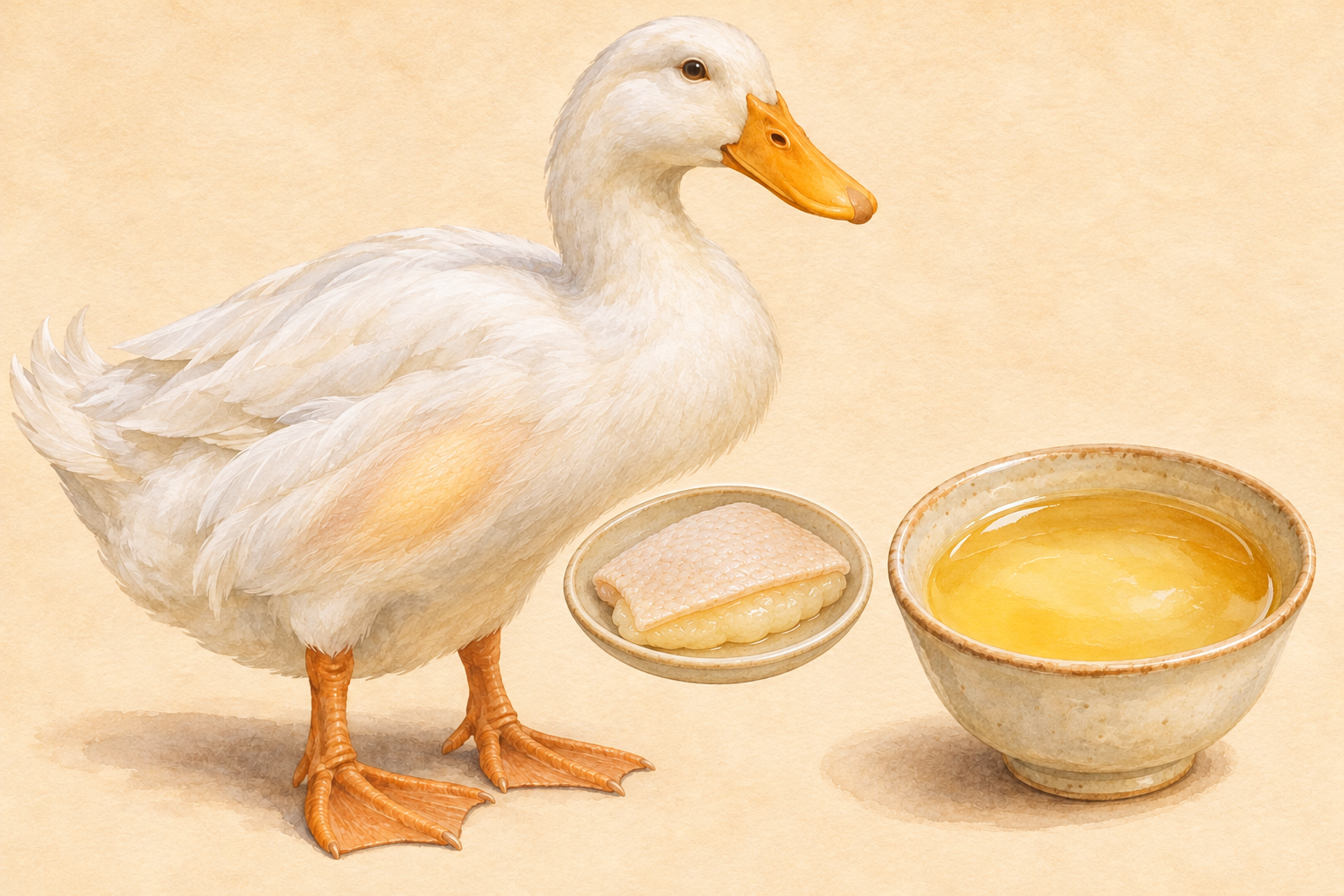
Duck fat is an edible fat separated from duck fatty tissues, used in confit and sautéed potatoes.
Source material
The source is fatty tissue of food ducks. A 2014 southwestern French specification proposal names Muscovy ducks, Cairina moschata, and mulard hybrids.
Composition
Ernest Soulard’s label gives 898 kcal, 99.8 g fat and 33.2 g saturated fat per 100 g of product. These figures are specific to that product.
Region
It is used in southwestern French confit. Nouvelle-Aquitaine’s regional food guide also describes saving confit fat for other cooking.
Food use
Ernest Soulard sells separated duck fat for cooking potatoes and meat.
Extraction
Fat is rendered and separated from solids. The 2014 specification proposal describes filtration of confit fat.
Safety
Soulard directs refrigeration at 0–4°C and consumption within three days after opening. Do not generalise this to other products or home-recovered fat; follow the relevant label and hygienic conditions.
Sources
Ernest Soulard, Graisse de canard: https://www.boutique-soulard.com/produits/graisse-de-canard Nouvelle-Aquitaine, Confit de canard et d’oie: https://www.produits-de-nouvelle-aquitaine.fr/les-produits-de-nouvelle-aquitaine/specialites/confit-de-canard-et-doie/ INAO, 2014 specification proposal: https://extranet.inao.gouv.fr/fichier/cdcigpcanardafoiegrasdusudouestv3.pdf