THE OIL ATLAS
Mongongo oil
Overview
Mongongo oil is separated from the kernels of Schinziophyton rautanenii (syn. Ricinodendron rautanenii) in southern Africa. PROTA documents San communities, especially in Namibia, boiling kernels to recover oil and using that separated oil in soups. This is evidence of culinary use of a distinct oil, not merely consumption of the nuts.
Source material
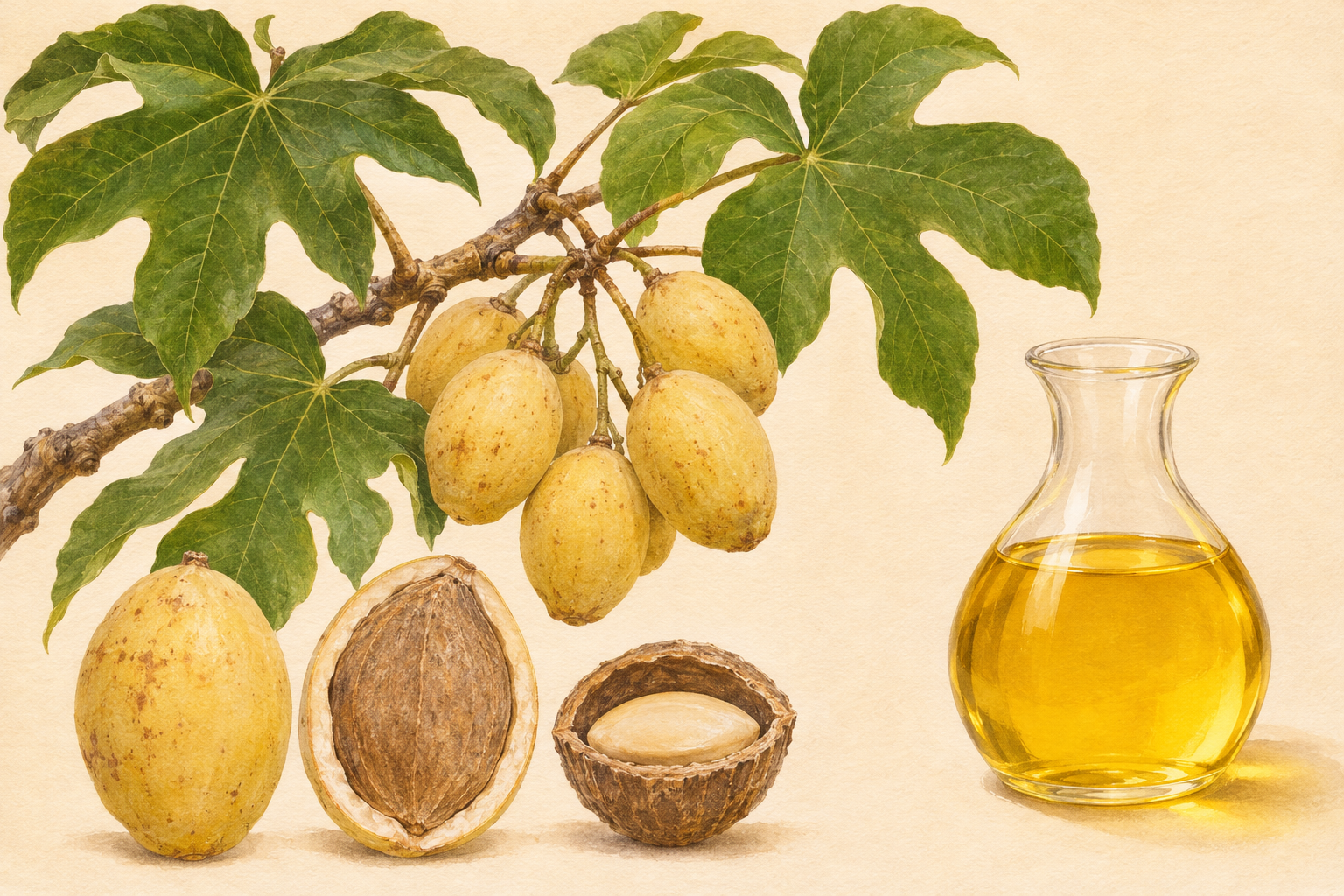
The oil-bearing material is the kernel within the hard fruit stone of Schinziophyton rautanenii. PROTA describes removing the pulp and hard shell. Eating the pulp, eating the kernels, and using oil separated from the kernels are different practices.
Composition
| Measure | Literature value | Material and basis |
|---|---|---|
| Fat in edible kernels | 57.3 g | Per 100 g kernel, 1969 analysis cited by PROTA |
| Linoleic acid | 38% | Fatty-acid composition of separated oil, PROTA |
| Oleic acid | 15% | Same basis |
| Alpha-eleostearic acid | 29% | Same basis |
Kernel fat per 100 g and fatty-acid percentages of extracted oil have different denominators. The presence of a conjugated fatty acid does not establish ordinary cooking-oil heat stability.
Region
PROTA places the species from southern DR Congo, southern Tanzania and Angola to Namibia, Botswana and northern South Africa. The particular culinary account of recovered oil used in soup concerns especially San communities in Namibia. The same practice is not assumed throughout the plant’s range.
Food use
PROTA explicitly records separated oil skimmed from boiled kernels, kept and subsequently used in soups. This documents culinary use of oil as a distinct material, rather than merely eating the kernels. No particular soup name or amount is specified. A 2018 food-composition study also reports the separated oil being eaten in Namibia with vegetables, chicken and spinach.
Extraction
After removing pulp and the hard stone shell, kernels are boiled in water. Oil rising to the surface is spooned off and stored for later use. PROTA records this traditional method among San people in Namibia. Roasting kernels for direct consumption is a different process.
Safety
Historical culinary use does not certify the suitability of any modern retail product. Verify food-grade labeling and storage conditions; do not ingest mongongo oil sold only for cosmetics or other non-food purposes. No unverified fatty-acid figures or shelf-life claims are supplied.
Sources
PROTA, *Schinziophyton rautanenii* (PROTA), Pl@ntUse: https://plantuse.plantnet.org/en/Schinziophyton_rautanenii_%28PROTA%29 (taxonomy, range, kernel boiling, skimming and soup use). “Characterization of Schinziophyton rautanenii (Manketti) nut oil from Namibia rich in conjugated fatty acids and tocopherol” (2018), Journal of Food Composition and Analysis 66:152–159, https://www.sciencedirect.com/science/article/abs/pii/S0889157517302934 (culinary use and oil analysis).