THE OIL ATLAS
Babassu oil
Overview
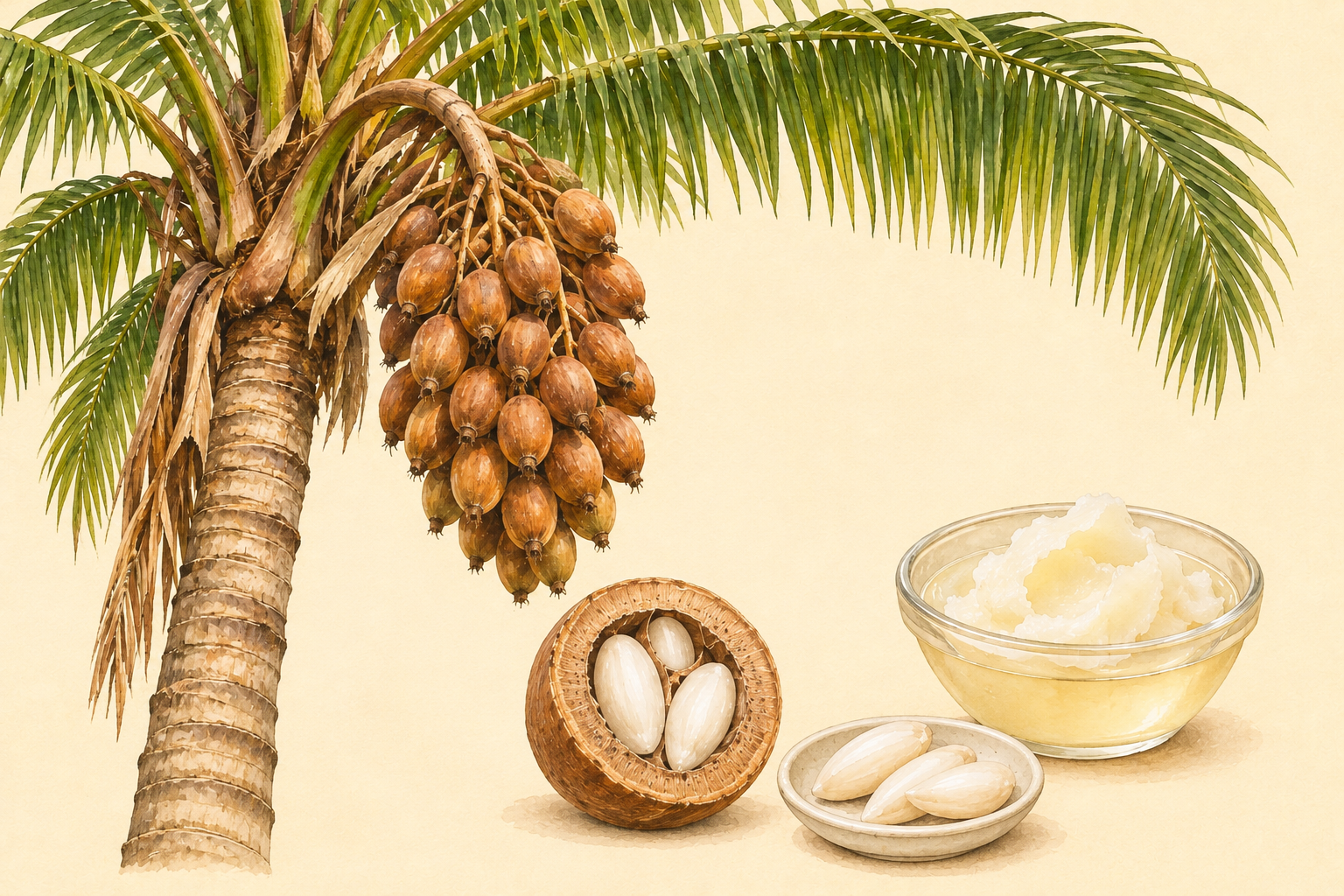
Babassu oil is extracted from kernels enclosed in the hard fruit of a Brazilian palm and has a documented role as a cooking oil in northern and northeastern Brazil.
Source material
The principal source is Attalea speciosa. The separated kernel oil is distinct from flour made from the fruit pulp.
Composition
| Measure | Measured value | Material, conditions and unit |
|---|---|---|
| Lauric acid | 47.40% | Brazilian cold-pressed oil analysed in 2019; % of total fatty acids |
| Myristic acid | 15.64% | Same sample; % of total fatty acids |
| Oleic acid | 11.28% | Same sample; % of total fatty acids |
| Palmitic acid | 8.01% | Same sample; % of total fatty acids |
| Linoleic acid | 1.85% | Same sample; % of total fatty acids |
| Total saturated fatty acids | 86.42% | Same sample; % of total fatty acids |
All figures refer to a particular sample in one study, not specifications for every babassu oil product. Source: 2019 study cited in the references.
Region
In northern and northeastern Brazil, notably Maranhão and Pará, gathering babassu fruits and recovering kernels are part of local livelihoods. An ethnobotanical survey around Tucuruí Lake in Pará found that 50.8% of respondents used the separated kernel oil in everyday cooking. This is a proportion within the surveyed group, not a national prevalence estimate.
Babassu oil is separated from the kernels enclosed within the hard fruit of the Brazilian babassu palm, principally identified as Attalea speciosa.
Food use
Babassu oil is used for cooking and as a salad dressing oil. This is distinct from “babassu milk,” prepared by processing the kernels with water and used in dishes including fish. The survey also documented weekly use of the latter; that should not be counted as evidence of using separated oil.
It is distinct from eating flour made from the fruit pulp or preparing drinks and foods from the kernels: the separated fat itself is used in cooking.
Extraction
Separating oil from babassu kernels differs from processing kernels with water to make babassu milk. The preparation of the milk must not be presented as the extraction method for the oil.
Safety
Select oil clearly sold for food use and handled hygienically. Babassu oil is also marketed for soap and cosmetic manufacture, so check the intended use. A fatty-acid analysis of one sample does not establish shelf life or health benefits for every product.
Babassu oil is rich in lauric acid, but flavor, melting behavior and storage characteristics can vary with processing and refining.
Sources
- https://www.scielo.br/j/abb/a/3963c8cZdXQYxLPVXFLWqHq/?lang=en - https://pmc.ncbi.nlm.nih.gov/articles/PMC9268242/