THE OIL ATLAS
Shea butter
Overview
Shea butter is a semi-solid edible fat extracted from tree kernels and used in West and Central African cooking as well as modern confectionery.
Source material
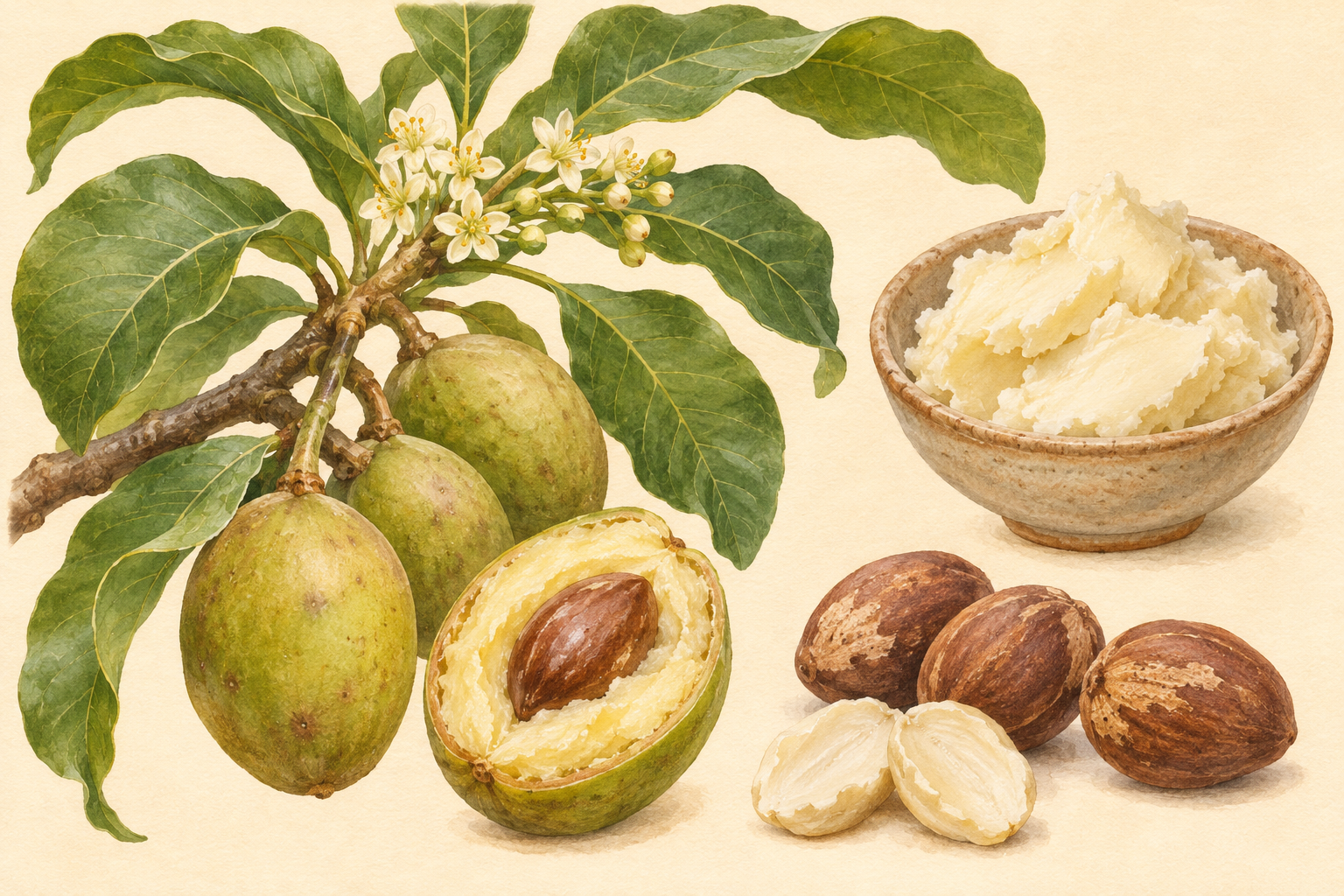
It comes from kernels inside the fruit of Vitellaria paradoxa (formerly Butyrospermum parkii), a Sapotaceae tree. Extracting the fat is distinct from eating the fruit pulp.
Composition
The FAO Edible nuts account gives literature composition ranges as a percentage of total fatty acids: oleic 49–50%, stearic 30–41%, palmitic 5–9%, and linoleic 4–5%. These are not results from one defined batch, nor specifications for every retail product.
| Fatty acid | Literature range (% of total fatty acids) |
|---|---|
| Oleic C18:1 | 49–50% |
| Stearic C18:0 | 30–41% |
| Palmitic C16:0 | 5–9% |
| Linoleic C18:2 | 4–5% |
Source: FAO, Edible nuts, shea section. The summary does not establish individual sample or analytical-method conditions.
Region
The tree is gathered and processed across the savanna belt of West and Central Africa. Shea processing has supported local diets and women’s livelihoods, including in Burkina Faso.
Food use
Shea butter is a separated kernel fat, not merely fruit pulp or nuts eaten whole. The National Academies documents its addition to the West African cereal staple tô to reduce surface drying and add flavour and texture, as well as its use in frying fritters and griddlecakes. Industrial cocoa-butter-equivalent applications are a separate use from household cooking.
Extraction
Traditional production removes fruit pulp, heats or dries the nuts, cracks their shells, crushes and roasts the kernels, then mills and kneads them with water. The separated fat is boiled and filtered. A UK research report on Ghanaian processing records a total of 8.5–9.5 hours for a 25 kg kernel example; this is not a universal production time.
Safety
Choose food-grade products. Water-based traditional processing requires attention to drying, contamination and storage. Cosmetic-grade shea butter should not automatically be treated as edible.
Sources
FAO, Edible nuts, shea section: https://www.fao.org/4/v8929e/v8929e.pdf National Academies, Lost Crops of Africa, Shea: https://www.nationalacademies.org/read/11763/chapter/19 FAO, Non-wood forest products: Shea nuts and butter: https://www.fao.org/4/i0527e/i0527e.pdf UK research report, traditional Ghanaian shea processing: https://assets.publishing.service.gov.uk/media/57a08db140f0b652dd001ae8/R6631_FTR.pdf