THE OIL ATLAS
Macadamia oil
Overview
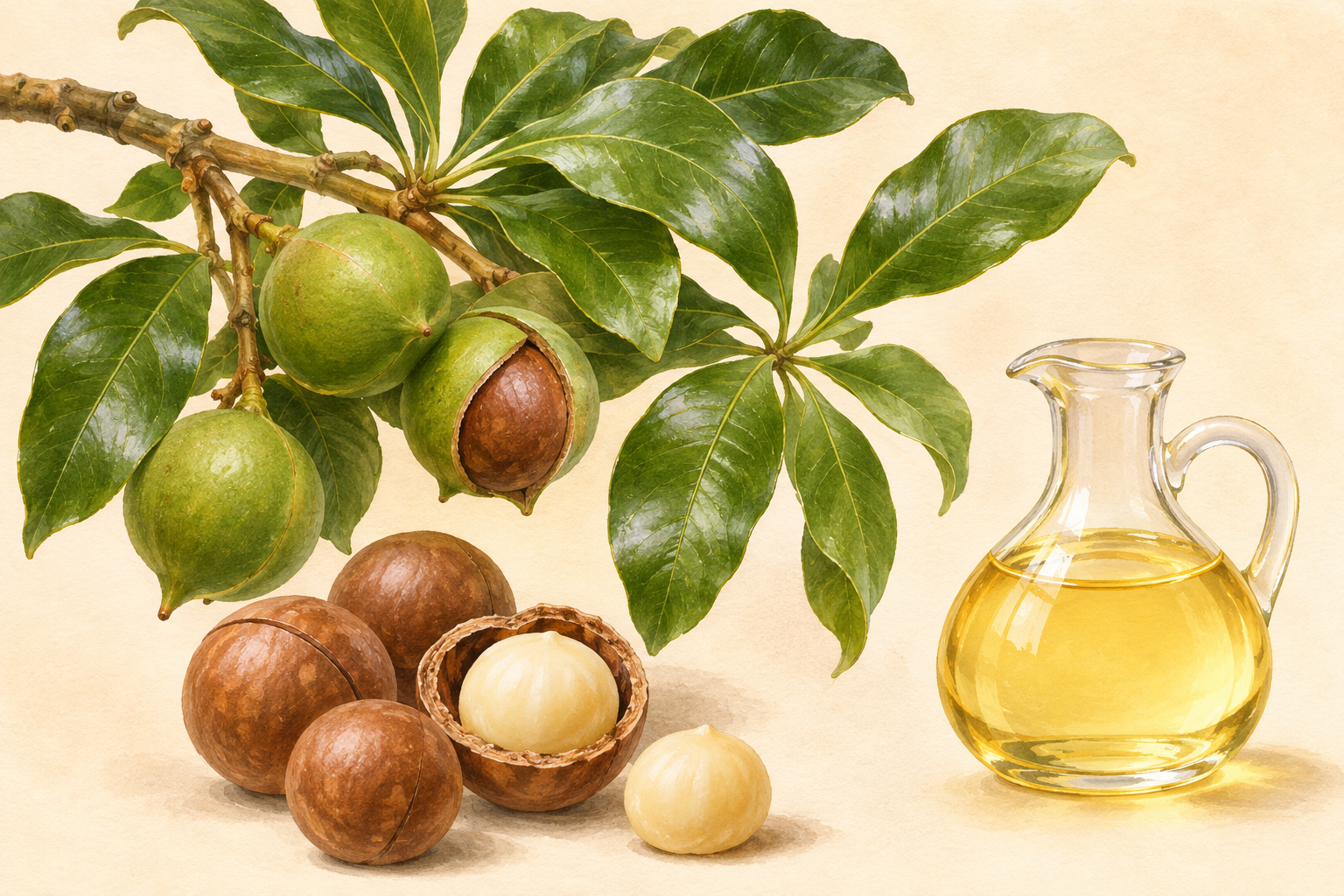
Macadamia oil is separated from kernels of Macadamia integrifolia, M. tetraphylla and their hybrids. It has a mild nut-like aroma.
Source material
The source is the kernel inside the hard shell. Kernels sold as nuts and graded kernels directed to oil pressing have different uses.
Composition
| Fatty acid | FAO composition example | Material, unit and source |
|---|---|---|
| Oleic acid | 59.9% | Analysed macadamia oil; percentage of total fatty acids; FAO, Minor Oil Crops |
| Palmitoleic acid | 21.9% | Same |
| Palmitic acid | 9.1% | Same |
| Linoleic acid | 1.9% | Same |
| Stearic acid | 2.2% | Same |
Region
Macadamias originate in eastern Australia and are cultivated in Australia, Hawaii and parts of Africa. These are growing regions, not an oil-production ranking.
Food use
FAO documents oil separated from edible macadamia kernels as a cooking oil. This differs from using whole nuts in sweets; a named traditional dish is not supplied without a supporting source.
Extraction
After harvest, macadamia fruits are dehusked and dried; the hard shells are cracked to recover the kernels. FAO’s Minor Oil Crops documents a process in which kernels are density-graded in brine and grade III kernels, not sold as edible nuts, are pressed in a small expeller. Fibrous presscake material may be added to improve pressing efficiency. This is one documented method, not a universal manufacturing process for all macadamia oils.
Safety
FAO notes that delays in dehusking and drying harvested nuts can cause fermentation and deterioration. Consider tree-nut allergies, choose food-grade rather than cosmetic oil, and store it sealed according to product instructions.
Sources
1. https://www.fao.org/4/x5043e/x5043E09.htm 2. https://agris.fao.org/search/en/providers/122535/records/65de224163b8185d9ca72c7f