THE OIL ATLAS
Hazelnut oil
Overview
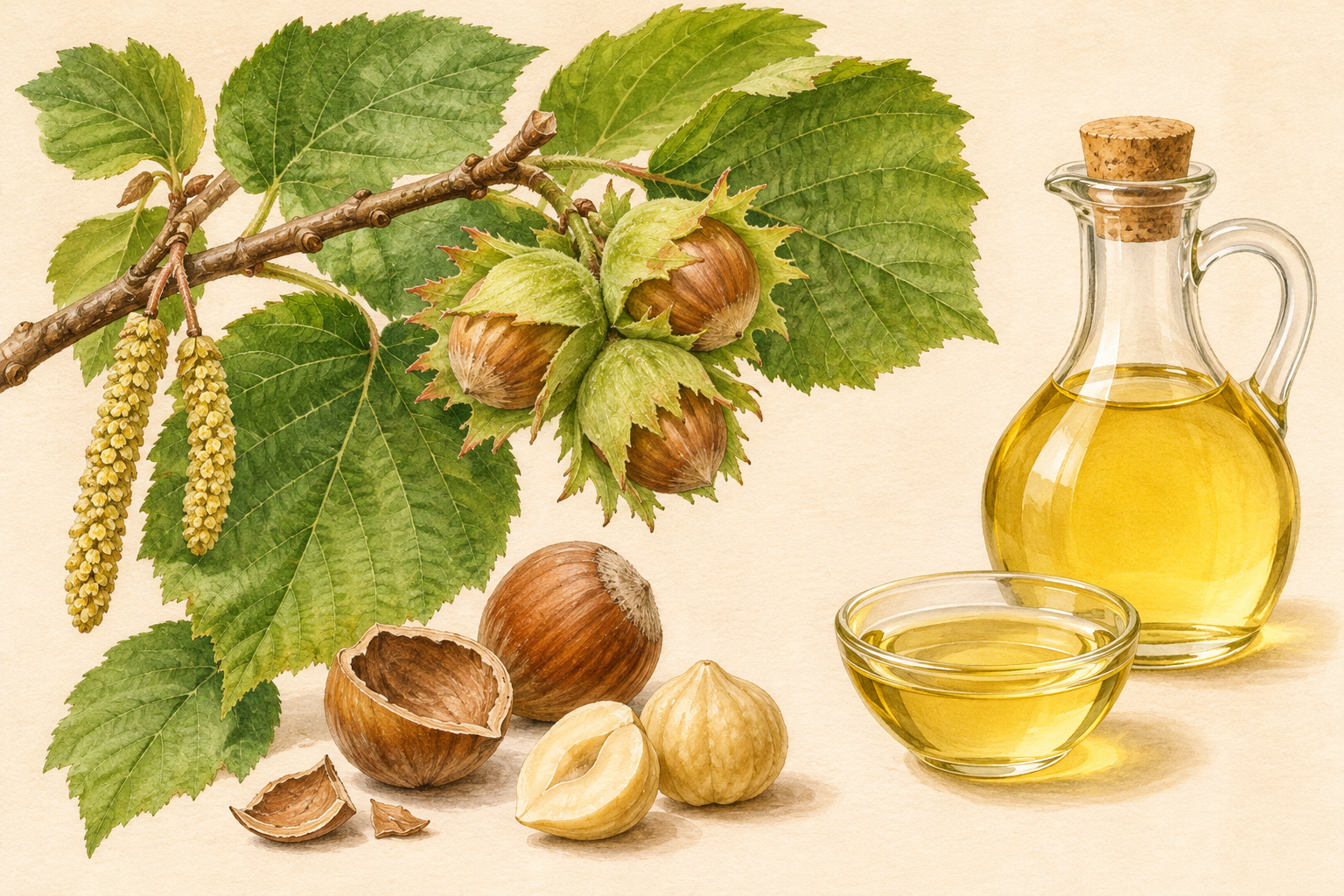
Hazelnut oil is an edible oil separated from hazelnut kernels. Oil pressed from roasted kernels has a toasted aroma, while unroasted kernels generally give a gentler flavour.
Source material
It is made mainly from the edible kernels of Corylus avellana. Eating hazelnuts and pressing their kernels into a separately used cooking oil are distinct practices.
Composition
| Measure | Value | Sample, conditions and source |
|---|---|---|
| Oleic acid | 84.08–84.68% | 2020 refining-stage study; percentage of total fatty acids in stage-specific oil samples |
| Linoleic acid | 6.79–8.56% | Same study and basis |
| Oleic acid, crude oil | 84.30±0.34% | Crude sample in the same study; share of total fatty acids |
| Linoleic acid, crude oil | 7.43±0.09% | Crude sample in the same study; share of total fatty acids |
| Vitamin E, crude oil | 23.78±0.76 mg/100 g | Crude sample in the same study |
| Vitamin E, after deodorization | 16.26±0.98 mg/100 g | Post-deodorization sample in the same study |
Region
In Piedmont in northwestern Italy, producers sell oil pressed from hazelnut kernels as a food. The local producer Agreasy recounts that farmers used small presses to obtain hazelnut oil during wartime shortages of conventional cooking oils. This is a producer’s account of local history, not definitive evidence of a uniform regional origin. “Nocciola Piemonte I.G.P.” identifies the protected geographical indication for the hazelnut ingredient; it does not by itself certify the bottled oil under a separate oil designation.
Food use
The Piedmontese producer Agreasy explicitly recommends its bottled hazelnut oil for carne cruda (raw meat), meat agnolotti, fresh tomini cheeses, pasta, and raw or boiled vegetables. These are uses of separated edible oil, not simply dishes containing whole nuts. A little oil added at the end of preparation can showcase its aroma. The examples are documented producer recommendations and should not be generalized to every traditional household recipe.
Extraction
Shelled European hazelnut kernels may be pressed either raw or after roasting; roasting tends to strengthen the nutty aroma. Cold pressing does not use solvents, while some industrial products undergo extraction followed by refining. A 2020 study comparing processing stages found that minor constituents may change during refining. Unrefined and refined oils should therefore not be assumed to have identical nutritional profiles.
Safety
Choose hazelnut oil made and labelled for food use; do not repurpose cosmetic-grade oil as food. People with hazelnut allergy should not assume that the degree of refining alone establishes safety. Protect aroma-sensitive oils from oxidation after opening, keep the container tightly closed, and follow the label for storage away from heat and light.
Sources
Duman & Özcan (2020), Journal of Food Science and Technology 57:2501–2506, doi:10.1007/s13197-020-04285-w (fatty acids and vitamin E in processing-stage research samples). Agreasy, “Hazelnut oil”, https://agreasy.it/en/prodotto/hazelnut-oil/ (producer evidence for separately sold edible oil, culinary uses, and its account of regional history; accessed 2026-11-18).