THE OIL ATLAS
Almond oil
Overview
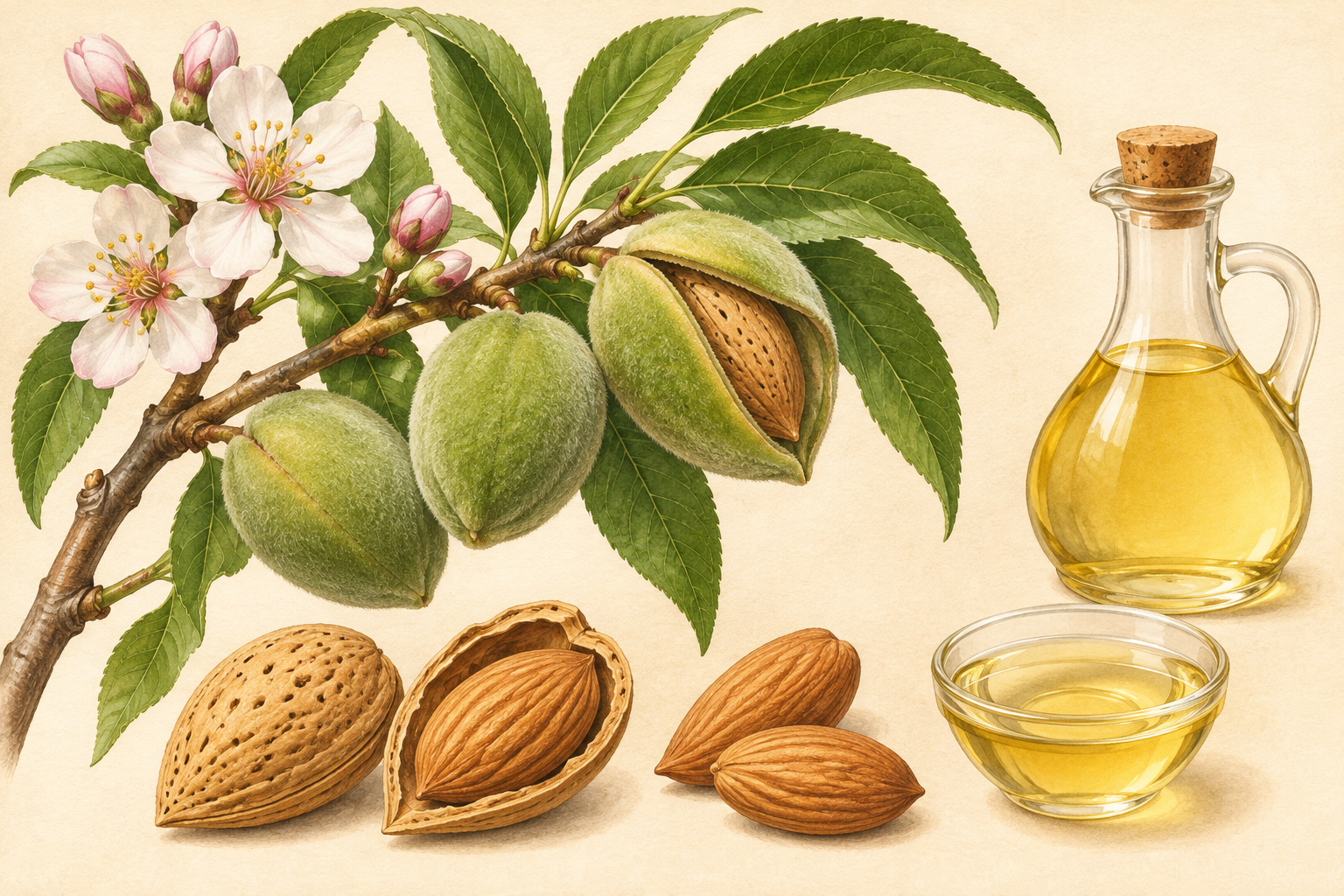
Almond oil is an edible fixed oil separated from kernels of Prunus dulcis. It is used in dressings and confectionery. Food-grade fixed oil must be distinguished from volatile bitter-almond aromatic oil, and tree-nut allergy precautions apply.
Source material
The source is the edible kernel inside the hard shell of the almond fruit, a member of the rose family.
Oil extracted from almond kernels is a different food from the kernels used in confectionery. Food-grade and cosmetic products should also be distinguished by their intended-use labels.
Composition
| Fatty acid | Analysis cited by FAO | Sample and unit |
|---|---|---|
| Oleic acid | 66.4% | Share of total fatty acids in separated almond oil |
| Linoleic acid | 23.5% | Same basis |
| Palmitic acid | 7.5% | Same basis |
| Stearic acid | 1.8% | Same basis |
The FAO figures describe the fatty-acid profile of extracted oil, not the nutrition of whole almond kernels. Oil does not supply the kernel’s fiber and protein in equivalent amounts.
Region
FAO identifies almond-growing regions including Italy, Spain, Morocco, France, Greece and Iran. These are source-crop regions, not a ranking of almond-oil production.
Food use
The separated oil is used in salads, sauces for seafood or chicken, fruit desserts and confectionery. These are documented contemporary culinary uses, not necessarily ancient regional recipes. Cold-pressed oil can have a mild nutty aroma.
Using almonds in confectionery is not the same as using extracted almond oil. The presence of almonds in a sweet does not by itself show that almond oil was used in its preparation.
Extraction
After drying, the shells are cracked and kernels pressed using screw or hydraulic presses, followed by filtration. Roasting and refining alter colour and aroma.
Product distinction: Edible fixed almond oil is lipid separated from kernels; it differs from volatile bitter-almond flavoring oils. Check the source material and food-grade labeling.
Safety
Choose food-grade fixed almond oil. It is not the volatile aromatic oil associated with bitter almonds, which must not be substituted in cooking. Consider tree-nut allergy and store opened oil to limit oxidation.
Sources
• https://www.fao.org/fao-who-codexalimentarius/sh-proxy/en/?lnk=1&url=https%253A%252F%252Fworkspace.fao.org%252Fsites%252Fcodex%252FMeetings%252FCX-709-27%252FWorking%2Bdocuments%252FREP19_FOe_compiled.pdf • https://www.fao.org/4/x5043e/x5043E0d.htm • https://www.fao.org/fao-who-codexalimentarius/sh-proxy/pt/?lnk=1&url=https%253A%252F%252Fworkspace.fao.org%252Fsites%252Fcodex%252FMeetings%252FCX-709-26%252FREPORT%252FFinal%252520REP19%252FREP19_FOe_compiled.pdf • https://pmc.ncbi.nlm.nih.gov/articles/PMC8151718/ • https://www.usda.gov/sites/default/files/documents/vegu-radio-august-30-culinary-and-cultural-connections-of-almonds-mp3.pdf • https://www.maison-guenard.com/en/content/33-our-oil-usage • https://www.almonds.org/why-almonds/almonds-in-many-forms/almond-oil • https://www.cbi.eu/sites/default/files/market-information/product-factsheet-almond-oil-germany-vegetable-oils-oilseeds-2014.pdf