THE OIL ATLAS
Apricot kernel oil
Overview
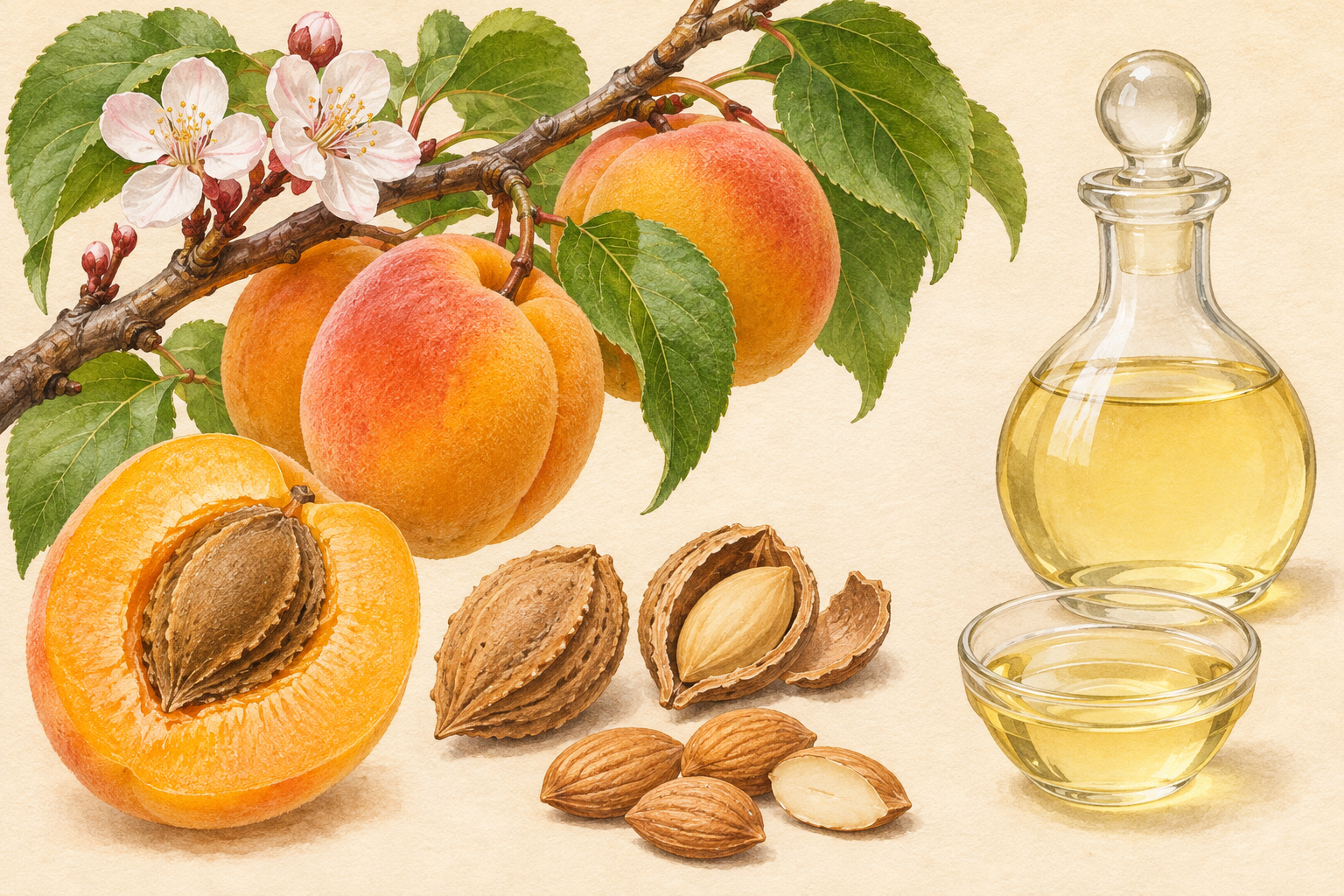
Apricot kernel oil is an oil separated from apricot kernels inside the stone. Cyanogenic hazards associated with kernels require separate assessment of food-grade oil safety.
Source material
Oil separated from the kernel inside the hard stone of an apricot (Prunus armeniaca). Eating apricot flesh, eating the kernel, and using the separated kernel oil as food are three distinct practices and require separate evidence.
Composition
Numerical values are not given without a source identifying the material, extraction method, sample conditions and units.
Region
Reviews document culinary use of oil separated from wild apricot kernels in the northwestern Himalayas of India, including Himachal Pradesh and villages in Ladakh. Fruit cultivation areas should not be equated with regions where the separated oil was used as food.
Food use
A review records wild apricot kernel oil being used in Himachal Pradesh as a cooking fat in place of ghee, and reports cooking use in villages of Ladakh. Another review describes uses in dressings, frying and baked foods. These accounts do not establish the regulatory status or suitability of every product currently sold.
Extraction
A traditional Ladakh process described in the literature removes kernels from stones, dries and crushes them, and recovers oil on a warmed stone with a small addition of water. Modern pressing, solvent extraction and refining are distinct processes; food-grade controls must be assessed separately.
Safety
Important: Do not eat raw apricot kernels. EFSA (2016) assessed the risk of cyanide release from amygdalin in apricot kernels. This is a hazard assessment of kernels, not a direct measurement of residual cyanogenic compounds in properly manufactured separated oil. Check the food-grade status and product-specific quality specifications; do not attempt home extraction for consumption.
Sources
EFSA (2016), *Apricot kernels pose risk of cyanide poisoning*: https://www.efsa.europa.eu/en/press/news/160427 (raw-kernel hazard; not evidence of culinary use of separated oil) EFSA Journal (2016), *Acute health risks related to the presence of cyanogenic glycosides in raw apricot kernels and products derived from raw apricot kernels*: https://doi.org/10.2903/j.efsa.2016.4424 (amygdalin and cyanide risk assessment). Pawar, K. R. & Nema, P. K. (2023), Apricot kernel characterization, oil extraction, and its utilization: a review, Food Science and Biotechnology 32, 249–263. https://doi.org/10.1007/s10068-022-01228-3 Value addition of wild apricot fruits grown in North–West Himalayan regions—a review (2015). https://pmc.ncbi.nlm.nih.gov/articles/PMC4571203/