THE OIL ATLAS
Black seed oil (Nigella sativa)
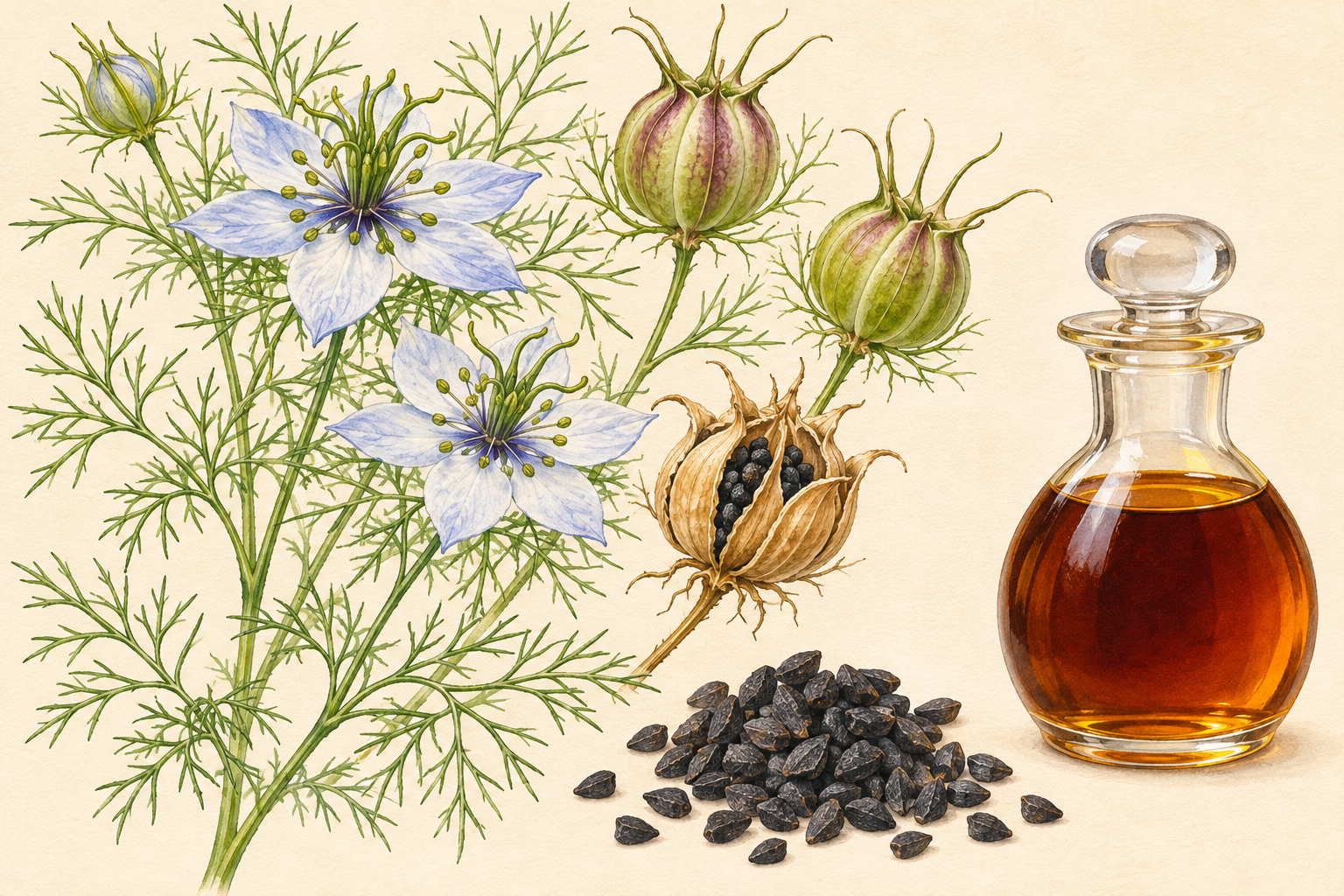
Overview
A fixed oil separated from the black seeds of Nigella sativa (Ranunculaceae). It is not cumin oil from Cuminum cyminum. Choose products specifically intended for food rather than assuming medicinal or cosmetic preparations are edible.
Source material
This fixed oil is separated from the seeds of Nigella sativa, for example by pressing. It is botanically distinct from cumin (Cuminum cyminum). Sprinkling the whole seeds on bread is not evidence that the separated oil was used in the same dish.
Composition
| Fatty acid | Egyptian sample | Syrian sample | Ethiopian sample |
|---|---|---|---|
| Linoleic | 62.3 ± 0.2% | 60.6 ± 0.3% | 61.4 ± 0.3% |
| Oleic | 21.0 ± 0.1% | 22.1 ± 0.1% | 21.8 ± 0.1% |
| Palmitic | 11.8 ± 0.1% | 11.8 ± 0.1% | 11.6 ± 0.1% |
Seed-oil samples from three origins in a 2024 comparative study. Values are mass percentages of total fatty acids; ± denotes standard deviation; analytical replicates n=3. Not guaranteed values for retail products. Source: Molecules 2024, 29, 4985 .
These figures compare samples from three origins; they are not representative specifications for every product from those countries. The ± values describe variation among analytical replicates, not permissible ranges for retail products.
Linoleic acid is the largest listed fatty-acid fraction in all three sampled origins. The three samples do not constitute a global average for black cumin oil.
Other cited sources give approximately 58% linoleic, 24% oleic and 12% palmitic acid for cold-pressed oil in a 2020 specialist book chapter (percent of total fatty acids). A 2007 analysis of solvent-extracted crude oil reports 57.3 ± 0.04%, 24.1 ± 0.03% and 13.0 ± 0.03%, respectively. These figures describe different samples and extraction conditions from the 2024 three-origin comparison; they should not be averaged. Sources: the 2020 book chapter and 2007 paper listed below.
Region
The origin of analyzed oil samples from places such as Egypt, Syria and Ethiopia does not by itself establish a traditional culinary region for the separated oil.
Food use
Using whole nigella seeds in bread and dishes is distinct from consuming the separated fixed oil. A 2019 product specification issued by an Egyptian producer describes cold-pressed, filtered black cumin seed oil for dressings, dips and vegetable dishes. This documents an actual food-oriented oil product, not a long-established use in any named traditional dish. A 2021 food-safety review also discusses seed oil as an adjunct for food flavouring. A 2024 heating study of oil pressed from a mixture of nigella and sunflower seeds concerns experimental food applications, not evidence that pure nigella oil has a traditional culinary role.
Extraction
Pressing and solvent extraction are two methods of separating fixed oil from the seeds; neither is equivalent to eating ground seeds. The fatty-acid figures from the existing three-origin comparison describe the oils analysed in that study, not every pressed, extracted or retail product. Processing information and sample conditions matter when comparing oils. A 2024 blending experiment combined black cumin and sunflower seeds at mass ratios of 100:0, 95:5, 90:10, 85:15 and 0:100 and obtained oils by cold pressing. The oils were studied during heating at 180 °C for 30–150 minutes; these are experimental conditions, not recommended home-cooking instructions.
Safety
Black-cumin seeds, fixed oil and volatile essential oil are different products. Choose fixed oil prepared for food use, not research extracts or essential oil as substitutes. Fatty-acid measurements from a study sample are not batch-wide quality guarantees. In the same study, acid value and p-anisidine value rose with heating time. Research into cooking-oil potential is not a guarantee of high-temperature safety or health benefits for every product. A food-oriented manufacturer specification does not establish regulatory approval in every jurisdiction or any therapeutic benefit. Heating suitability depends on the product and processing method.
Sources
1. *Molecules* (2024), 29, 4985 https://doi.org/10.3390/molecules29214985: fatty-acid analysis of seed oils from Egypt, Syria and Ethiopia; not a survey of culinary prevalence. 2. Cold-pressed oil reference chapter (2020): https://doi.org/10.1016/B978-0-12-818188-1.00006-2 3. Analysis of solvent-extracted crude oil (2007): https://academic.oup.com/ijfst/article/42/10/1208/7863919
4. Evaluation of the qualitative properties of the oil extracted from the mixture of Helianthus annuus and Nigella sativa seeds during heating (2024), Scientific Reports, https://www.nature.com/articles/s41598-024-68463-y 5. Egyptian Herbarium, Nigella Seeds Oil, product data sheet, version 03 (2 Jan 2019), https://egyptianherbarium.com/wp-content/uploads/2019/12/TDS-Nigella-Seeds-Oil.pdf (manufacturer evidence for culinary use; not independent proof of historical tradition). 6. Assessment of black cumin (Nigella sativa L.) as a food ingredient and putative therapeutic agent (2021), https://www.sciencedirect.com/science/article/pii/S0273230021002294.