THE OIL ATLAS
Poppy seed oil
Overview
A fixed edible oil pressed from mature poppy seeds, historically used in European salads and other cold dishes.
Source material
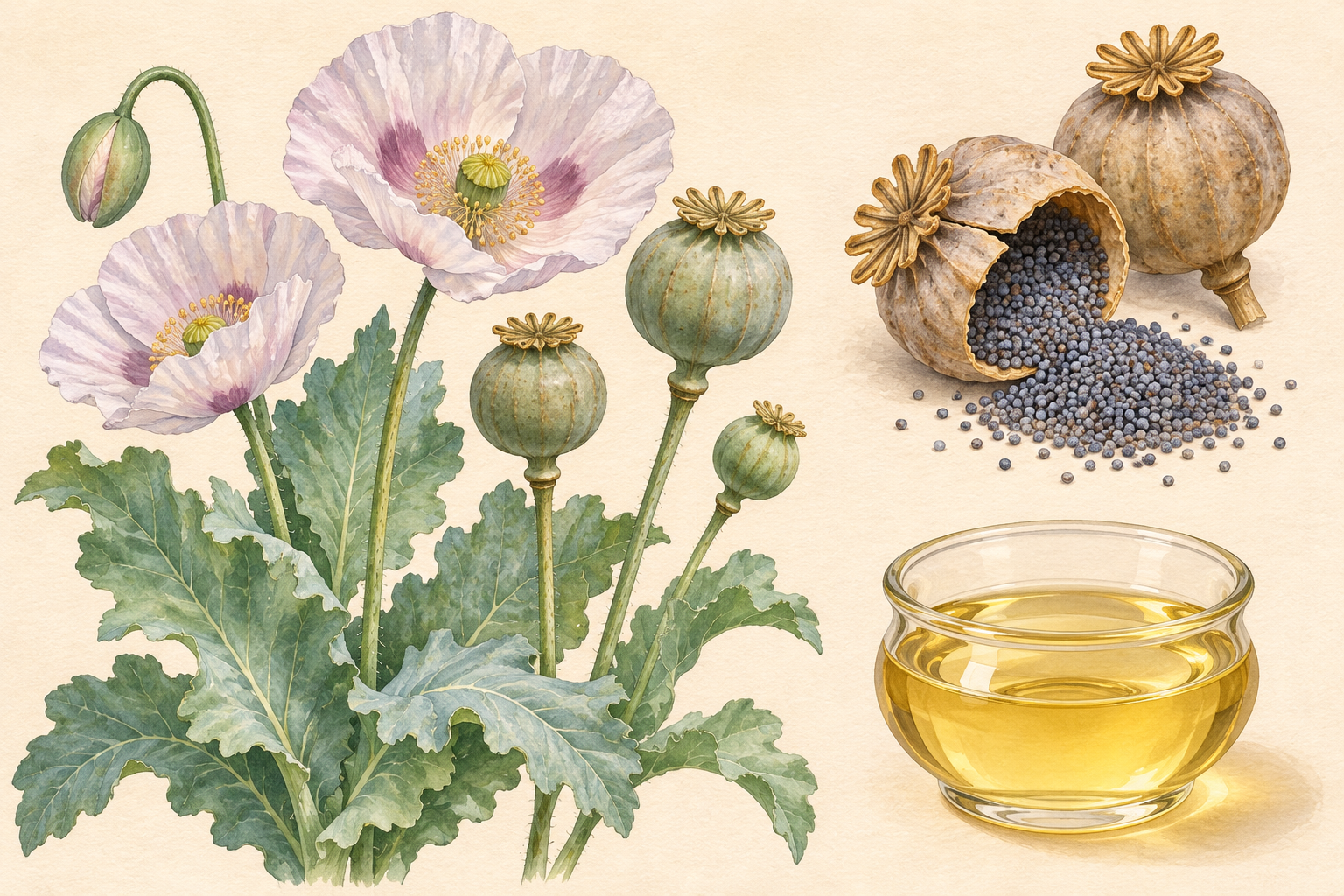
The raw material is the mature seed of Papaver somniferum L. Eating seeds on bread or in pastries is distinct from consuming separated oil.
Composition
| Measure | Reported value | Material, unit and conditions |
|---|---|---|
| Linoleic acid | 56–75% | Literature range; % of total fatty acids in separated oil |
| Oleic acid | 10–20% | Literature range; % of total fatty acids in separated oil |
| Palmitic acid | 10–16% | Literature range; % of total fatty acids in separated oil |
| Beta-tocopherol | 309.5–567.3 ppm | Study of separated oils from seven Turkish cultivars |
| Crude oil content of seeds | 32.43–45.52% | Percentage of seed material, not the fatty-acid profile of separated oil |
These are literature and study ranges reported in the cited literature, not universal retail specifications.
Region
Use is documented in Austria, Germany, Hungary and Poland. Historically, pale oil from initial cold pressing was distinguished from later hot-pressed oil used for lighting, soap or artists’ materials.
Food use
Food-grade cold-pressed oil is pale and gently nutty, used in salads, cold dishes and meat marinades.
It is distinct from eating whole poppy seeds on bread or in pastries: oil is mechanically extracted and used independently as a culinary ingredient, including in salads and other cold dishes.
Extraction
Oil is separated from mature seeds by mechanical pressing or other extraction. Processing grade affects quality and intended use.
Historically, the first low-temperature pressing and subsequent heated pressings of poppy seed served different purposes. Accounts of lamp or soap oil from later pressings must not be presented as evidence of food use.
Safety
Opium alkaloids such as morphine may contaminate the surface of poppy seeds during harvesting; this does not establish a fixed concentration in the resulting oil. Choose food-grade products made from controlled raw materials and protect them from light, heat and air. Food-grade poppyseed oil should be distinguished from poppy-derived medicines and from the issue of alkaloid residues that may occur on seed surfaces.
Sources
1. https://efsa.onlinelibrary.wiley.com/doi/10.2903/j.efsa.2018.5243 2. https://www-pub.iaea.org/MTCD/Publications/PDF/te_781_web.pdf 3. https://www.fibl.org/fileadmin/documents/shop/1244-oilseeds.pdf 4. https://pmc.ncbi.nlm.nih.gov/articles/PMC11723419/ 5. https://grasasyaceites.revistas.csic.es/index.php/grasasyaceites/article/view/33