THE OIL ATLAS
Egusi seed oil
Overview
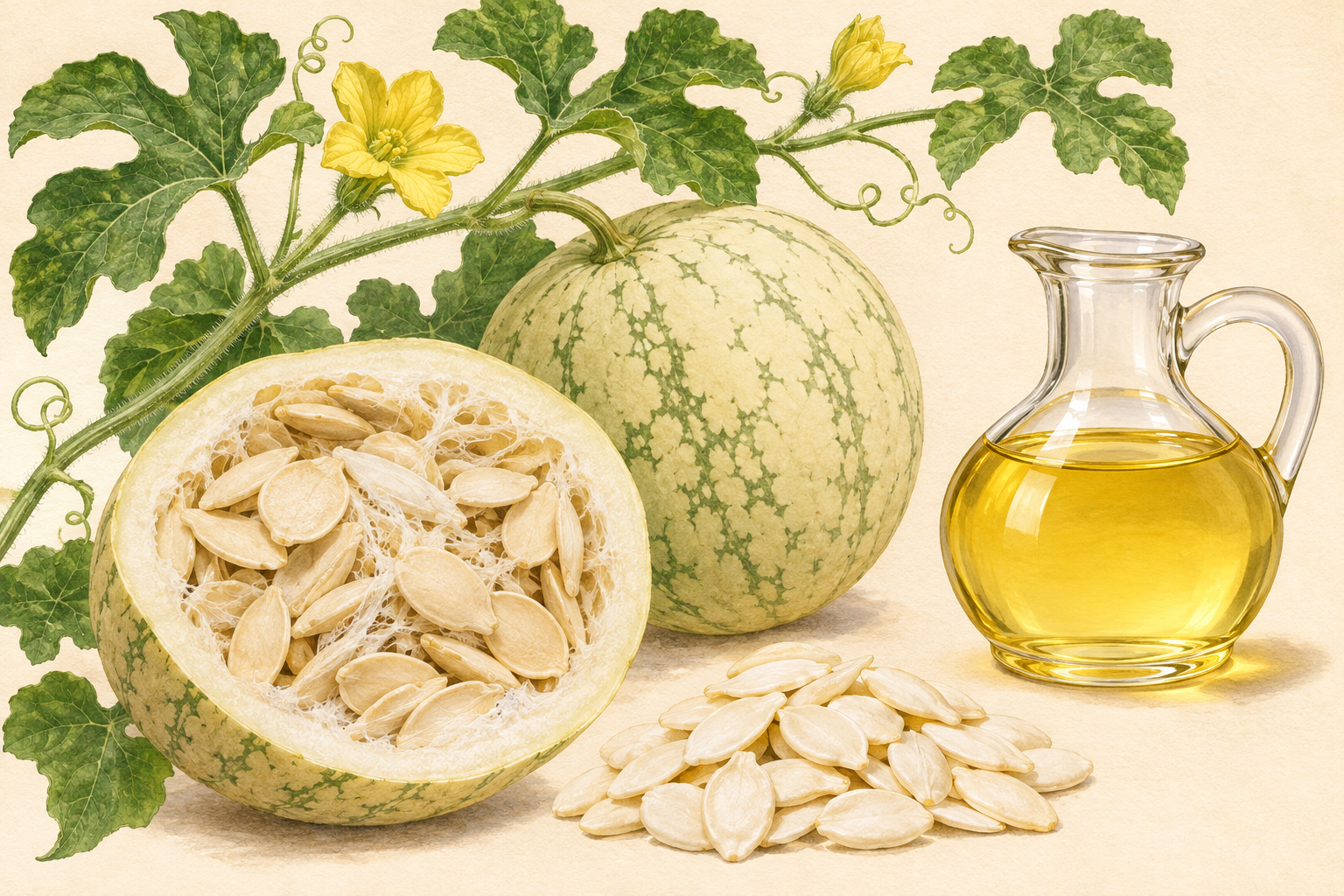
Egusi refers to edible seeds of several cucurbit species in West and Central Africa. Beyond cooking with the seeds themselves, a documented example from northern Ghana describes use of the separated oil for cooking.
Source material
Egusi is not one species: the name covers edible seeds of several cucurbits in West and Central Africa, including Citrullus lanatus, Cucumeropsis mannii and Lagenaria siceraria. Identifying the plant used for a particular oil matters.
Composition
| Measure | Value reported | Material, unit and limitation |
|---|---|---|
| Oil content | Over 50% on average | Proportion of oil in dehulled edible kernels; not the nutritional composition of extracted oil |
| Linoleic acid | About 63% | One analyzed separated egusi oil, percentage of total fatty acids |
| Oleic acid | About 16% | The same oil analysis, percentage of total fatty acids |
The name egusi covers several cucurbit species. These fatty-acid proportions must not be generalized to oils from every species or region. Sources: National Academies and FAO references listed in the references.
Region
Egusi seeds are part of food cultures in Benin, Cameroon, Ghana, Nigeria and Togo. A National Academies source reports cooking with separated egusi oil in northern Ghana. The distribution of dishes made from ground seeds should not be equated with the distribution of extracted oil.
Food use
Ground egusi seeds added to soup and oil separated from those seeds for cooking are different food uses, even when both are called egusi. The oil used in cooking is the focus here; dishes made only with ground seeds are a different use.
Extraction
Seeds are recovered from the fruit, washed, dried and sometimes dehulled before oil is separated from seeds or kernels. The cited sources do not establish one shared pressing device or heating temperature across regions.
Safety
Use food-grade products and consider species identity, oxidation and contamination. A single nutritional or safety profile cannot be assumed for every plant called egusi.
Sources
1. https://www.nationalacademies.org/read/11763/chapter/10 2. https://openknowledge.fao.org/3/cc5044en/cc5044en.pdf