THE OIL ATLAS
Flaxseed oil
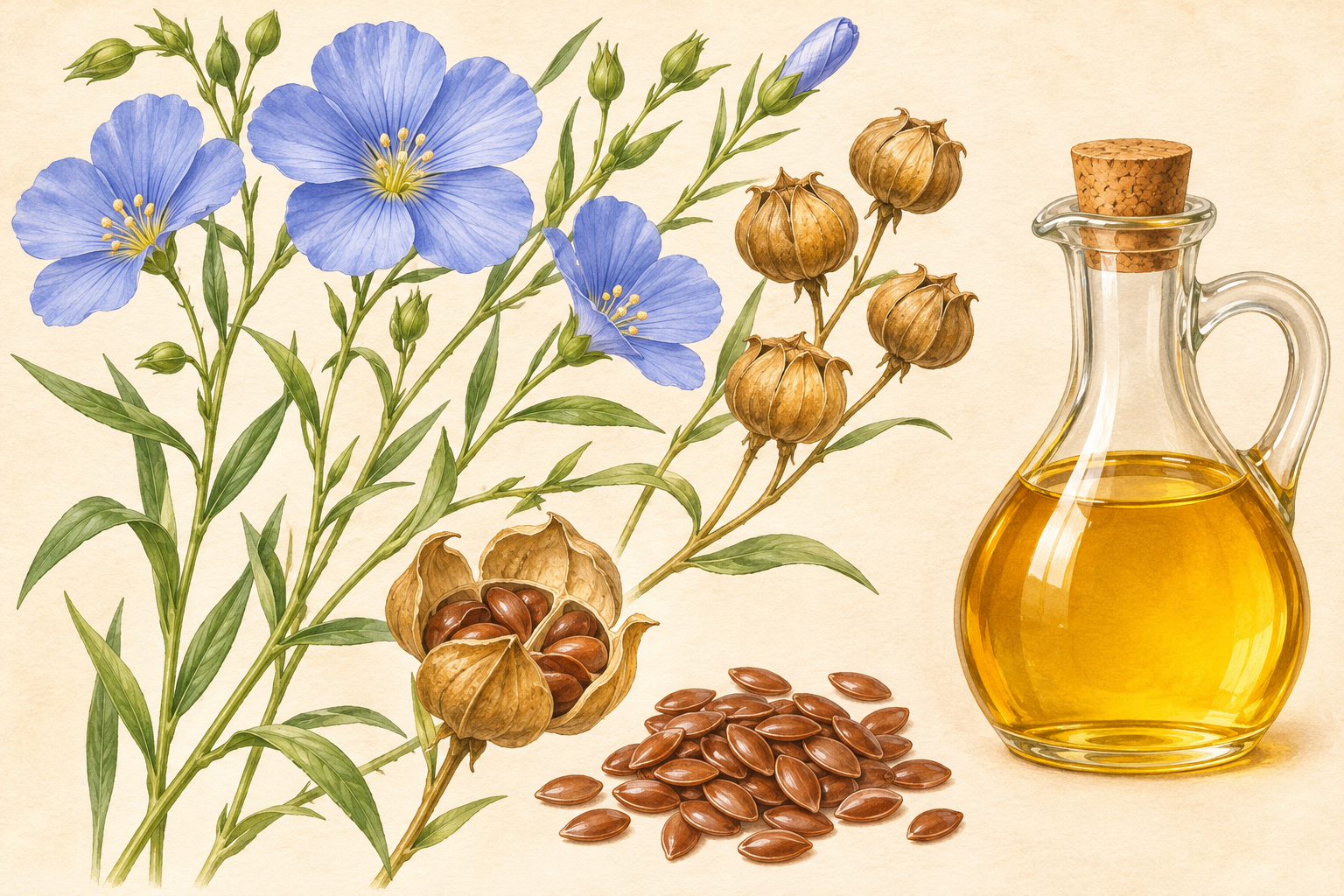
Overview
Flaxseed (linseed) oil is an edible oil pressed from flax seeds and notably rich in the omega-3 fatty acid alpha-linolenic acid. In Germany’s Lusatia region it is traditionally served with potatoes and quark. Industrial linseed oil intended for paints or other non-food uses must not be eaten.
Source material
The oil comes from seeds of flax, Linum usitatissimum L., as defined in Codex for flaxseed/linseed oil. Eating flaxseed itself and consuming the separately extracted oil are different practices.
Composition
Codex CXS 210-1999, Table 1, gives ranges for authentic flaxseed oil as percentages of total fatty acids; these are not measurements of any one retail product.
| Fatty acid | Codex range (%) |
|---|---|
| Palmitic C16:0 | 4.0–11.3 |
| Oleic C18:1 | 9.8–36.0 |
| Linoleic C18:2 | 8.3–30.0 |
| Alpha-linolenic C18:3 | 43.8–70.0 |
High alpha-linolenic content does not establish the oxidation state or shelf life of a specific bottle.
Region
In Lusatia (Lausitz), eastern Germany, edible linseed oil is produced and sold as a traditional regional specialty. The Saxony regional-products authority documents a local oil mill and regional food uses; the Spreewald tourism association likewise describes the oil’s place in local cuisine.
Food use
A characteristic preparation combines boiled jacket potatoes (Pellkartoffeln), quark and linseed oil. Saxony’s regional-products account also identifies marinated herring, quark dishes, cheese marinades and salad dressings. It is commonly added as a finishing oil rather than used as an all-purpose deep-frying fat.
Extraction
Oil is pressed from flax seeds. For Lusatian linseed oil, the Saxony source describes cold pressing followed by filtration through paper or cloth, preserving a characteristic golden appearance. Food-grade production and industrial linseed-oil production have different quality controls and intended uses.
Safety
Never use industrial linseed oil that is not labelled for food. Because this oil is rich in polyunsaturated fatty acids, follow product directions for cool, light-protected storage and use promptly after opening. A German edible-oil producer advises against strong heating such as deep-frying.
Sources
Codex Alimentarius, CXS 210-1999, §2.1 and Table 1 (fatty-acid composition ranges; % of total fatty acids). Saxon State Ministry / regionales.sachsen.de, Lausitzer Leinöl, https://www.regionales.sachsen.de/spezialitaeten/details/lausitzer-leinoel ; Spreewald Tourism Association, Linseed oil, https://www.spreewald.de/en/the-spreewald/regional-products/spreewald-specialties/linseed-oil ; Ölmühle Solling, How to Take Flaxseed Oil, https://www.oelmuehle-solling.de/en/how-to-take-flaxseed-oil.html