THE OIL ATLAS
Peanut oil
Overview
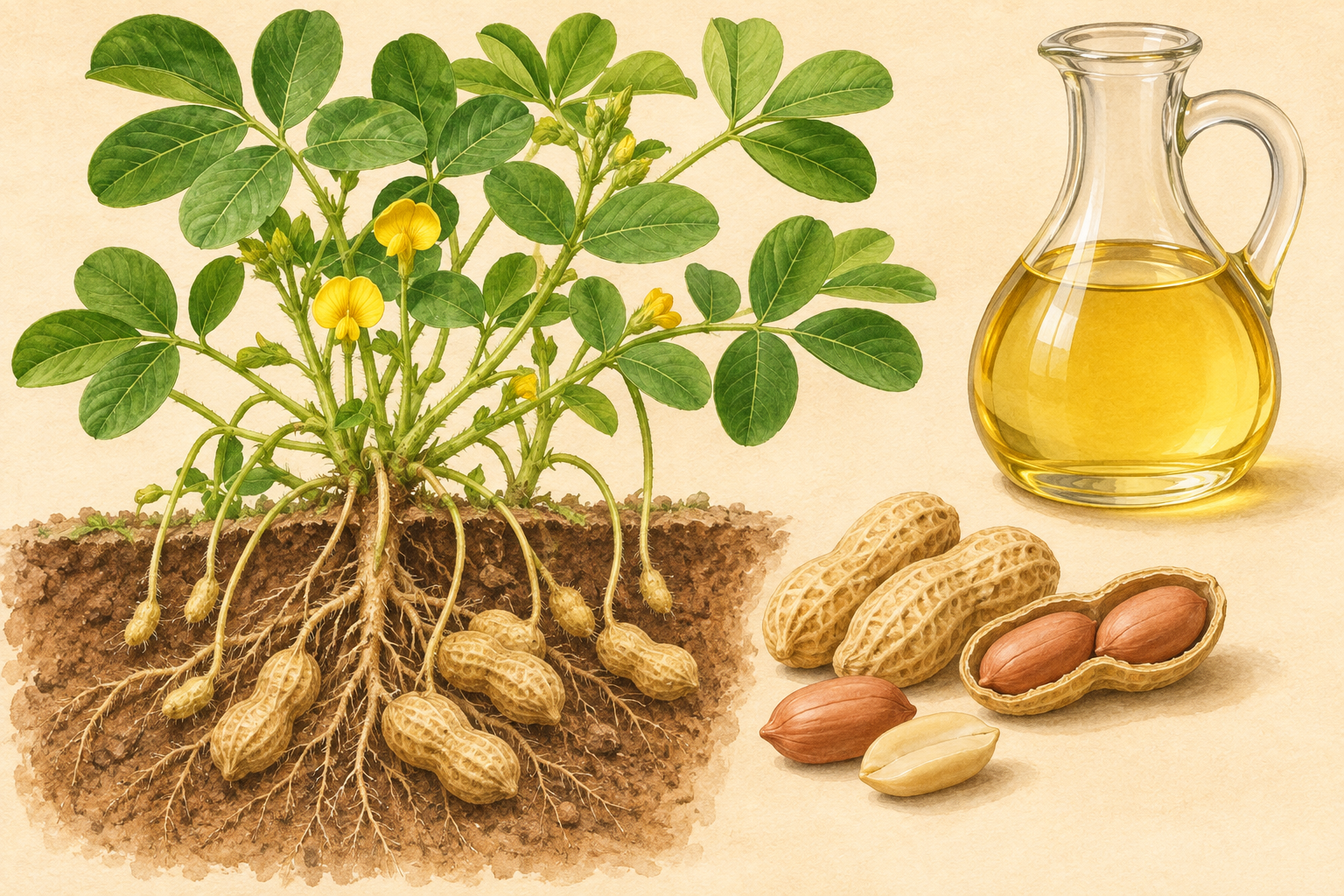
Peanut oil is an edible oil separated from the seeds of Arachis hypogaea. Toasted, aromatic oils and more neutral refined oils serve different culinary purposes. People with peanut allergy should check product-specific labelling and medical advice, including for refined oils.
Source material
The source is the seed of Arachis hypogaea. The oil is also called groundnut oil or arachis oil.
Composition
Codex CXS 210-1999 (2026-amended publication), fatty-acid ranges for authentic samples:
| Fatty acid | Percentage of total fatty acids |
|---|---|
| Oleic acid (C18:1) | 35.0–80.0% |
| Linoleic acid (C18:2) | 4.0–43.0% |
These identification ranges reflect variation among authentic samples, not grams per 100 g of finished oil or guaranteed values for an individual product.
Food use
Refined peanut oil is used for stir-frying and deep-frying; unrefined oil may be selected for its nutty aroma in sauces and dishes. Refining reduces much of the characteristic aroma, so the two product types are not interchangeable in flavour.
Roasted oil can be chosen for its nutty aroma, while refined oil is better suited when the ingredients should lead. Allergy precautions take priority over flavour preference.
Extraction
Roasting seeds before extraction gives a different aroma from oil that has undergone further refining and deodorisation.
Roasting chiefly develops aroma, whereas deodorizing refinement reduces it. The two products should not be described as having the same flavour.
Safety
Peanut allergy warning. Unrefined and cold-pressed oils may retain allergenic peanut proteins and should be avoided by people with peanut allergy. Highly refined oil is tolerated by many allergic individuals, but this is not a guarantee of individual safety. UK allergen-labelling rules cover both refined and unrefined peanut oil, unlike the US exemption for highly refined oils. Confirm the oil type in restaurants and products, and follow medical advice where appropriate.
Whether an oil is labelled highly refined, unrefined or cold-pressed matters when considering possible residual allergenic proteins.
Sources
Anaphylaxis UK, Peanut oil factsheet, https://anaphylaxis.org.uk/factsheets/peanut-oil/ ; Food Allergy Research & Education, Peanut, https://www.foodallergy.org/living-food-allergy/food-allergy-essentials/common-allergens/peanut ; Culinary oils and their health effects (2008), DOI:10.1111/j.1467-3010.2008.01738.x.
Region
Peanut oil is used as a cooking oil in Chinese cuisine, while refined oil is also sold and used for frying in countries including the United Kingdom. Aromatic unrefined peanut oil is used in some Chinese, Indian and Thai dishes for flavour. These are culinary uses of separated oil, distinct from eating peanuts.